 By
ByAWS Acquires DuckLabs: The Team Behind DuckDB Joins Amazon Cloud, Open‑Source Projects Remain Independent
AWS to acquire DuckLabs on Aug 26 (closes Sept). DuckDB stays MIT‑licensed under its independent Foundation; the 30+ person team joins AWS to strengthen analytics.
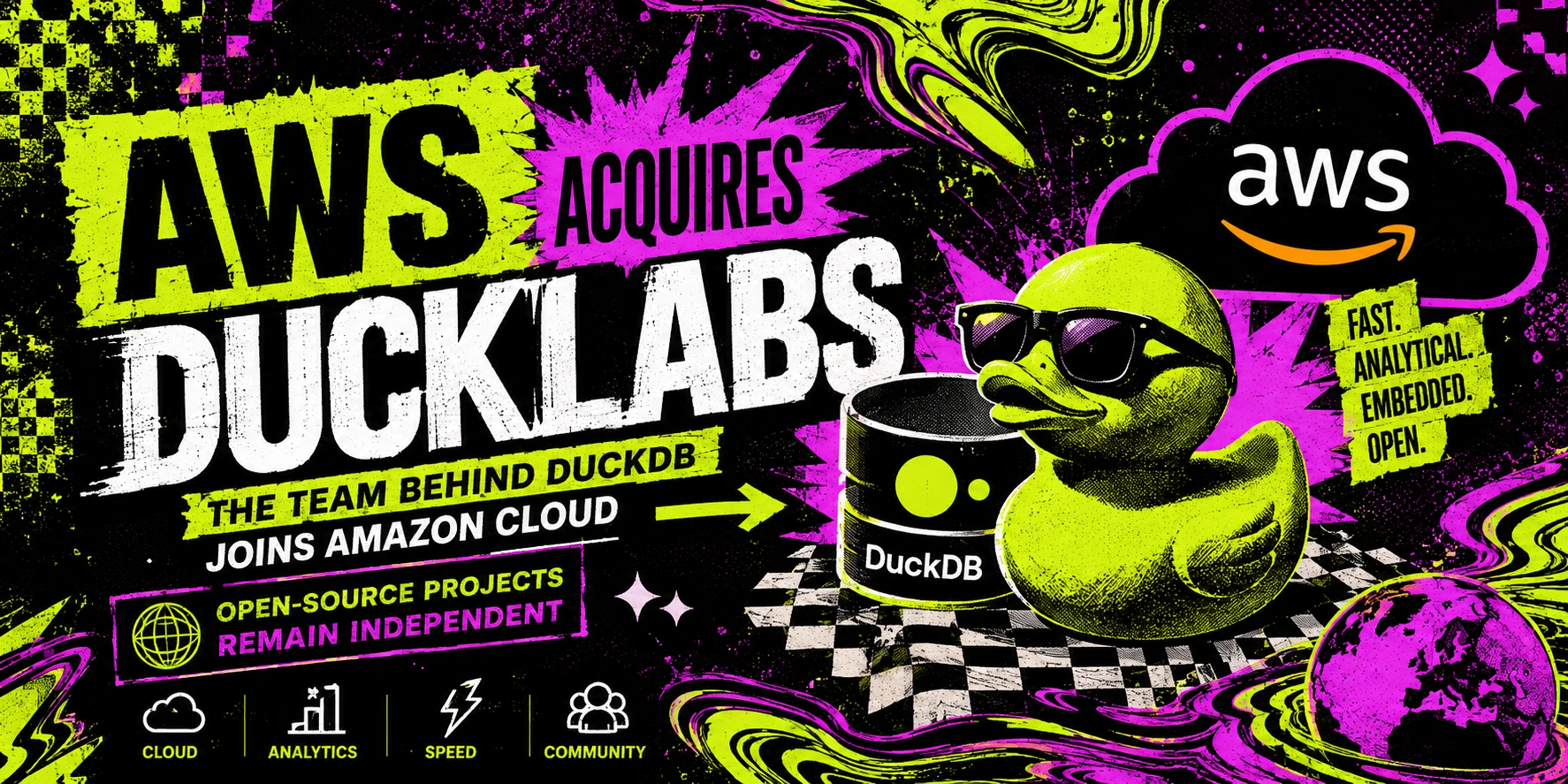
Amazon Web Services (AWS) officially announced on August 26, 2026, that it has signed a definitive agreement to acquire DuckLabs, the company behind the open‑source analytical database DuckDB. DuckLabs is headquartered in Amsterdam, the Netherlands, and employs a team of over 30 people. The deal is expected to close in early September, with financial details not disclosed.
What Is Being Acquired – and What Is Not
A crucial distinction in this acquisition is that AWS is buying DuckLabs – the company and its engineering team – but not the DuckDB open‑source project itself.
In its official announcement, AWS made it clear that DuckDB, DuckLake, Quack, and related extension projects will continue to be available as free and open‑source software under the MIT license, independently operated and maintained by the non‑profit DuckDB Foundation. The project’s roadmap, licensing model, and governance structure will not change as a result of this transaction.
Hannes Mühleisen, co‑creator of DuckDB and CEO of DuckLabs, stated that after joining AWS, the Foundation’s role will expand further, becoming a neutral platform where DuckDB stakeholders can gather and communicate. The Foundation is considering establishing a technical advisory committee to allow commercial users to provide input on the project’s roadmap.
DuckDB: From Academic Project to Developer Favorite
DuckDB originated at the Centrum Wiskunde & Informatica (CWI) in Amsterdam and was spun out as an independent company, DuckLabs, about five years ago. Unlike most startups, DuckLabs never took external venture capital; it has been wholly owned by its founders and employees, sustaining operations through support and development contracts.
DuckDB is an embedded analytical database written in C++ that runs inside the host process, eliminating the need for a separate database server. Its Python package allows users to run queries directly on Pandas data frames without importing or copying data, a design that has made it popular as “the SQLite of analytics.”
DuckDB released version 1.0 in 2024 and has since expanded into the data lake space through projects like DuckLake. Adoption has grown rapidly – DuckLabs reported daily downloads exceeding 3 million at one point, over 40,000 GitHub stars, and total Python package downloads surpassing 625 million, with a monthly average of about 40 million downloads in 2026.
AWS and DuckLabs: A Growing Partnership
The acquisition builds on an existing collaboration. AWS and DuckLabs have worked together since 2024, and in early 2025 they jointly added support for Amazon S3 Tables and SageMaker Lakehouse to DuckDB. Andy Warfield, Vice President and Distinguished Engineer at AWS, had previously expressed excitement about the release of DuckLake.
After the acquisition, DuckDB co‑creators Hannes Mühleisen and Mark Raasveldt will continue to lead the team and the technical direction of the open‑source project.
Impact on AWS’s Analytics Business
The acquisition is widely viewed as a strategic move in the data analytics space. DuckDB has strong developer credibility in the lightweight embedded analytical database segment, and bringing its core team in-house helps AWS fill a gap in lightweight analytics.
Justin Copie, CEO of AWS partner Innovative Solutions, commented: “For our mid‑market customers, there has always been a gap between spreadsheets and a full Redshift cluster. DuckDB fits right into that gap, and now AWS owns it.”
AWS reported $42.2 billion in revenue for the second quarter of 2026. Analysts believe the deal will not have a material short‑term impact on Amazon’s stock price but is likely to enhance AWS’s analytical capabilities and support its broader cloud strategy.
It is worth noting that DuckDB is cross‑platform – it can read and write Google Sheets and query Google BigQuery datasets through extensions. This means AWS will have a core development team that works with competing cloud platforms, underscoring the importance of the DuckDB Foundation’s independent governance mechanism.
Where DuckLabs Fits in AWS
Based on the information available at this early stage, the core of the transaction is talent and technology integration, not project closure. AWS gains a world‑class database engineering team, while the DuckDB open‑source project retains its independence through the Foundation.
AWS stated that the DuckLabs team’s expertise in database engineering and “developer‑loved software” will help the company deliver “faster, simpler, and more cost‑effective” analytics services to customers.
For the DuckDB developer community, the most notable takeaways are: the team joins AWS, the project remains open‑source, governance stays independent, and integration paths are yet to be defined. As the deal closes and product integration plans are revealed, the concrete role of DuckDB within the AWS ecosystem will become clearer.