 By
ByHKU Team Discovers Piezoelectric Effect in Diamond Films
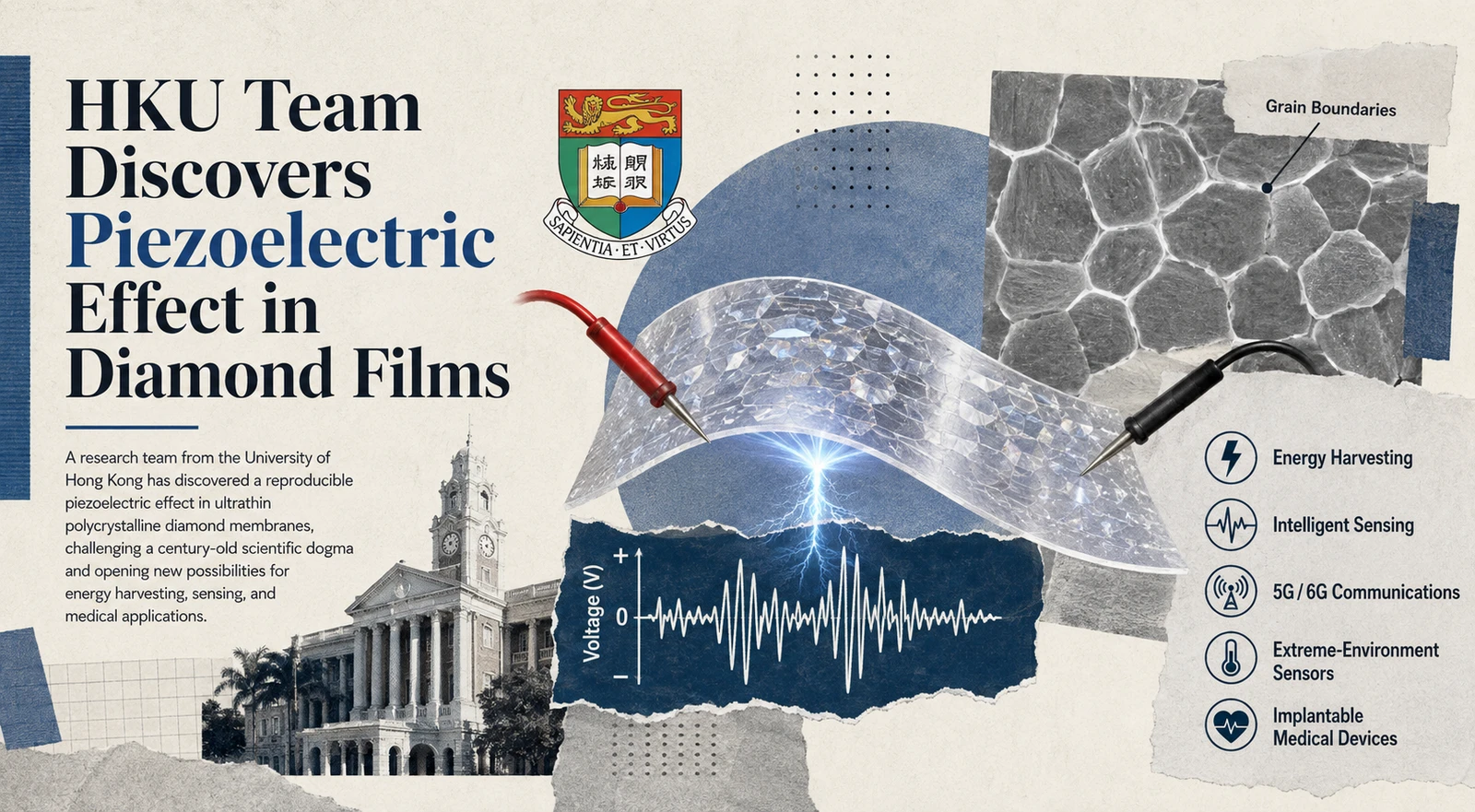
A research team from the University of Hong Kong has discovered a reproducible piezoelectric effect in ultrathin polycrystalline diamond membranes, challenging a century-old scientific dogma and opening new possibilities for energy harvesting, sensing, and medical applications.
For more than a century, diamonds have been universally classified as non-piezoelectric materials. Despite possessing exceptional hardness, high acoustic velocity, ultrahigh thermal conductivity, and an ultrawide bandgap, diamond has been relegated to the role of a passive mechanical substrate or heat sink in microelectromechanical systems (MEMS)—never an active functional material. The very idea of "generating electricity from diamonds" was once dismissed as impractical.
That assumption has now been overturned. A research team led by Professor Zhiqin Chu, Associate Professor in the Department of Electrical and Computer Engineering, and Professor Yuan Lin, Professor in the Department of Mechanical Engineering at the University of Hong Kong (HKU), has reported a significant and reproducible piezoelectric effect in ultrathin and ultraflexible polycrystalline diamond membranes. Their findings were published in Science Advances on March 18, 2026, under the title "Uncovering piezoelectric effect in polycrystalline diamond membranes" (DOI: 10.1126/sciadv.aea8318).
Breaking a Century-Old Dogma
Since the 1900s, the global scientific community has classified diamond as a non-piezoelectric material. Piezoelectricity—the ability of a material to generate electric charge under mechanical stress, or to deform in response to an applied electric field—requires a non-centrosymmetric crystal structure. Diamond's highly symmetric cubic crystal lattice was long thought to preclude any such effect.
The HKU team's discovery fundamentally challenges this assumption. By fabricating ultrathin polycrystalline diamond membranes—rather than working with bulk single-crystal diamond—they uncovered a previously unrecognized source of piezoelectricity that emerges at the nanoscale.
The Edge-Exfoliation Method: Enabling the Discovery
The breakthrough was made possible by an edge-exfoliation method previously developed by the same team. This technique, which was published in Nature in 2024 and recognized as one of China's Top 10 Scientific Advances of 2025, enables the scalable fabrication of inch-scale, sub-micron-thick, ultra-flat, and flexible polycrystalline diamond films. The method completes in seconds what traditional laser slicing and substrate etching require tens of hours to achieve, dramatically reducing production cost and time.
The resulting membranes exhibit sub-nanometer surface roughness and can be bent up to 360 degrees—properties impossible for bulk diamond. This extraordinary flexibility is what made the piezoelectric discovery possible: only by bending an ultra-thin diamond membrane could the team observe the voltage signals that had been hidden for over a century.
Experimental Evidence: Rigorous and Repeatable
When the diamond membrane was subjected to bending deformation, stable voltage signals were generated on opposite surfaces. To ensure the utmost scientific rigor, the team conducted extensive mechanical cycling tests under various controlled conditions, systematically ruling out potential environmental noise, triboelectric artifacts, and surface electrostatic effects.
The results were unequivocal: the electrical outputs were consistent and repeatable across numerous test cycles, confirming that the piezoelectric response is a genuine material property rather than an experimental artifact. The team verified that charge polarization exists within the bulk of the material, not merely on the surface.
Crucially, the piezoelectricity was found to be thickness-dependent, with the peak response observed in membranes approximately 5 micrometers thick. At this thickness, the membrane exhibited a piezoelectric voltage coefficient of approximately 82.2 mV·m/N—a value that surpasses many conventional piezoelectric materials.
The Mechanism: Grain Boundary Asymmetry
First-principles calculations revealed the physical origin of this unexpected piezoelectricity. In polycrystalline diamond membranes, the material consists of numerous diamond grains separated by grain boundaries. These grain boundaries introduce local structural asymmetry that is absent in perfect single-crystal diamond.
When the membrane is deformed, charge polarization accumulates at the grain boundaries, creating a potential difference between the upper and lower surfaces. This mechanism is fundamentally different from traditional piezoelectricity, which arises from non-centrosymmetric crystal structures. Instead, the piezoelectricity in polycrystalline diamond membranes emerges from the collective behavior of grain boundaries under strain—a finding that rewrites the textbook understanding of piezoelectric materials.
Applications: From Energy Harvesting to Implantable Medicine
The discovery combines diamond's inherent properties—biocompatibility, chemical stability, non-toxicity, high-temperature resilience, and ultrawide bandgap—with a newly discovered active functionality. This convergence opens doors across multiple frontier domains:
- Energy harvesting: Converting mechanical vibrations, body movements, and ambient motion into electrical energy, reducing dependence on traditional batteries.
- Intelligent sensing: High-precision deformation and pressure sensors for industrial and wearable applications.
- Next-generation communications (5G/6G): Leveraging diamond's ultrahigh acoustic velocity for high-power RF filters and acoustic wave devices.
- Extreme-environment sensors: Operating in aerospace, deep-well exploration, and nuclear industry settings where high temperature and pressure destroy conventional sensors.
- MEMS devices: High-performance actuators and transducers for medical instruments and industrial automation.
- Self-powered implantable medical devices: Diamond's biocompatibility and the ability to harvest energy from body movement could enable battery-free or never-replace-battery cardiac pacemakers and physiological sensors.
Recognition and Industry Translation
The discovery has garnered significant international attention. At the 51st International Exhibition of Inventions of Geneva (March 11–15, 2026), the team—working in collaboration with DiamNEX, a diamond technology company founded by Professor Chu—was awarded a Gold Medal for the "Piezoelectric Diamond Membranes" project. This follows their 2024 Gold Medal at the same exhibition for the edge-exfoliation mass-production technology.
The technology has already been protected by multiple patent applications, forming a strong intellectual property portfolio. DiamNEX, as the key industrialization partner, played an important role in experimental validation, performance optimization, and commercial pathway assessment—exemplifying the deep integration of academia and industry.
The cross-institutional collaboration also involved Southern University of Science and Technology and Peking University Dongguan Institute of Optoelectronics, with key contributors including Dr. Jixiang Jing, Dr. Bicong Wang, and other team members.
A New Era for Diamond Materials
This research does more than correct a century-old classification error. It pioneers an entirely new avenue for the functionalization of diamond materials, transforming diamond from a passive substrate into an active functional material. Combined with the team's prior breakthrough in scalable membrane fabrication, the path from laboratory discovery to industrial application is clearer than ever.
As Professor Chu and Professor Lin's team continues to push the boundaries of diamond science, the vision of "smart diamond" technologies—self-powered, biocompatible, and capable of operating in the most extreme environments—moves from imagination to reality.
- Jing, J., Wang, B., Luo, Y., et al. (2026). Uncovering piezoelectric effect in polycrystalline diamond membranes. Science Advances. DOI: 10.1126/sciadv.aea8318.
- University of Hong Kong. (2026). HKU researchers discover piezoelectric effect in diamond membranes, challenging century-old scientific dogma. HKU Press Release. https://www.hku.hk/press/news_detail_29115.html
- 超硬材料网. (2026). 香港大学领衔团队再创巅峰:压电金刚石膜技术斩获日内瓦国际发明展金奖. https://www.idacn.org/news/52587.html
- 半月谈. (2026). 2025年度中国科学十大进展. http://www.banyuetan.org/kj/detail/20260325/1000200033136211774423389677913745_1.html