 By
ByZ.ai Releases GLM-5.3-Flash: A 320B-Parameter Multimodal Model for Coding and Agent Workflows
Z.ai has released GLM-5.3-Flash, the first natively multimodal model in the GLM-5 series. With 320B total parameters, 18B active parameters, a 1M-token context window, and a low-cost API, the model is designed to deliver strong performance across coding, agentic tasks, and long-context workloads.
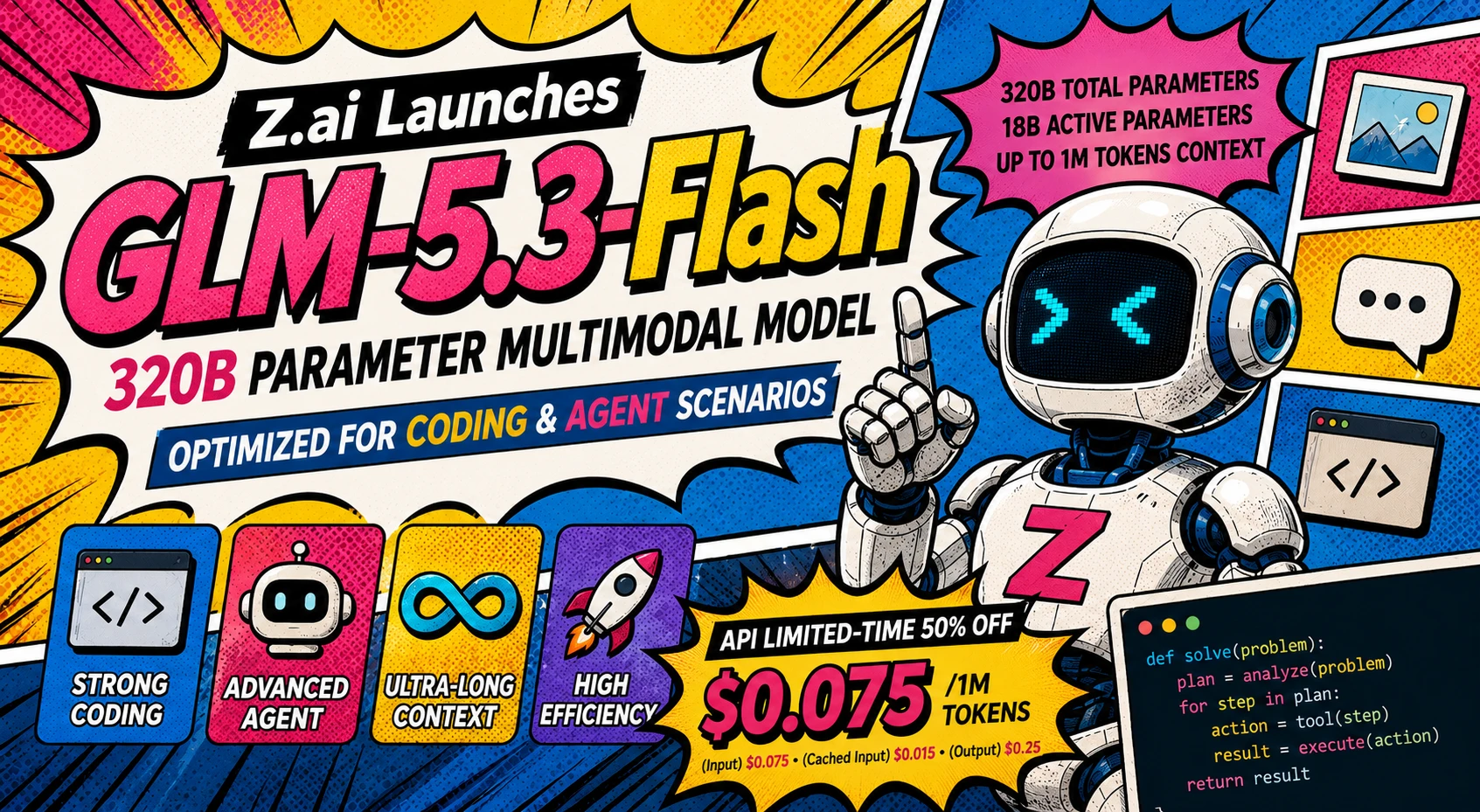
Z.ai officially released GLM-5.3-Flash on August 26, 2026. It is the first natively multimodal model in the GLM-5 series, and Z.ai positions it as an efficient model for coding, agentic workflows, and long-context tasks.
GLM-5.3-Flash uses a Mixture-of-Experts (MoE) architecture with 320 billion total parameters and 18 billion active parameters. It supports a context window of up to 1 million tokens and combines sparse attention with linear attention to reduce the computational and serving costs associated with long-context workloads.
From the Anonymous Ox Alpha Model to the Official Release
Before revealing its identity, Z.ai deployed GLM-5.3-Flash under the name Ox Alpha on platforms including OpenCode and OpenRouter to gather feedback from real-world users.
Z.ai later confirmed that Ox Alpha was GLM-5.3-Flash. The company said that the inference traffic during this testing phase ran entirely on Chinese AI chips. This early deployment gave the model exposure to practical developer workloads before its official release.
However, because the exact user population, task distribution, and testing conditions of the anonymous deployment were not fully disclosed, those results are better treated as early usage signals rather than standardized benchmark evidence.
Coding and Agentic Performance
The published benchmark results show that coding and agentic workloads are among GLM-5.3-Flash's main areas of strength.
On Terminal-Bench 2.1, GLM-5.3-Flash scored 84.3, compared with 81.0 for GLM-5.2. On DeepSWE v1.1, it scored 63.4, up from 46.2 for GLM-5.2.
For agentic evaluations, GLM-5.3-Flash scored 78.4 on Toolathlon Verified and 48.8 on AutomationBench v1.0.6, compared with 59.9 and 26.2 respectively for GLM-5.2.
The model also performs competitively against several closed-weight models on some tests. For example, Terminal-Bench 2.1 scores are 85.0 for Claude Opus 4.8 and 84.3 for GLM-5.3-Flash, while Toolathlon Verified scores are 76.2 and 78.4 respectively.
These figures should not be interpreted as evidence that the models have identical overall capabilities. Benchmark configurations, reasoning settings, tools, and evaluation harnesses can differ, so individual benchmark scores are better used to understand relative performance on specific tasks than to establish a universal ranking.
Native Multimodal Capabilities
Another major change in GLM-5.3-Flash is its native multimodal capability.
Z.ai says the model was trained using a multimodal pre-training corpus containing approximately 30 trillion tokens. It can accept image and text inputs, enabling applications such as visual agents that can inspect interfaces and interact with web pages or graphical environments.
The published vision results are mixed but competitive. GLM-5.3-Flash scores 89.4 on CharXiv Reasoning with Tools and 78.0 on Chartography with Tools, while other tests show stronger results from competing models. This suggests that its primary positioning remains coding and agentic work with multimodal capabilities, rather than specialized vision performance across every benchmark.
320B Total Parameters, 18B Active Parameters
The model's architecture is another important part of the release.
GLM-5.3-Flash has 320B total parameters and 18B active parameters and uses a hybrid sparse- and linear-attention architecture. Z.ai says the design reduces attention-related computation by roughly 3x compared with GLM-5.3 and reduces KV-cache requirements by approximately 4.4x. It also introduces IndexPool to compress key vectors in the indexer and further reduce long-context serving costs.
The distinction between total and active parameters is important. An 18B active parameter count does not mean that GLM-5.3-Flash is an 18B-parameter model. The 320B figure represents the full model, while 18B describes the parameters activated for each inference step.
Low-Cost API Pricing
Pricing is another major part of GLM-5.3-Flash's positioning.
Z.ai's current list price is:
- Input: $0.15 per 1 million tokens
- Cached input: $0.03 per 1 million tokens
- Output: $0.50 per 1 million tokens
Z.ai is currently offering a 50% promotional discount, reducing those rates to $0.075, $0.015, and $0.25 respectively. The promotion is scheduled to end at 24:00 on September 9, 2026, Singapore time.
Independent analysis from Artificial Analysis currently gives GLM-5.3-Flash an Intelligence Index score of 57, placing it among the leading models tracked by the benchmark. Artificial Analysis also reports approximately 50.2 output tokens per second and a 1.47-second time to first token based on Z.ai's API. The analysis describes the model as highly capable but relatively verbose and slower than the average of comparable models.
Artificial Analysis estimates a blended cost of about $0.09 per Intelligence Index task, while noting that its benchmark generated substantially more output tokens than the median model in the evaluation.
Open Weights and Local Deployment
In addition to API access, Z.ai has made the model weights publicly available under the MIT License. The company currently lists SGLang, vLLM, and TokenSpeed among the supported inference frameworks for local deployment.
The large total parameter count remains relevant for deployment planning. Although only about 18B parameters are active for each inference step, the complete 320B-parameter model still requires substantial hardware resources for self-hosting. Open weights therefore provide deployment flexibility, but do not imply that the full model can run comfortably on a typical consumer PC.
Where GLM-5.3-Flash Fits
Based on the currently available release information and independent testing, GLM-5.3-Flash is primarily positioned around coding, tool use, long-context processing, and agentic workflows rather than as a model optimized solely for general-purpose chat.
Its combination of relatively high benchmark performance, open weights, native multimodal input, 1M-token context, and low API pricing makes it particularly relevant for developers building or using coding agents. At the same time, the available evidence is still limited because the model was only released on August 26, 2026, and independent long-term evaluations are just beginning to accumulate.
Overall, GLM-5.3-Flash represents a significant efficiency-focused expansion of the GLM-5 family. Its architecture is designed to reduce inference costs while maintaining strong performance on coding and agentic tasks, and its native multimodal capability broadens the model's potential applications beyond text-only workflows.
As more independent benchmarks and real-world development results become available, its position relative to other frontier models should become clearer. For now, the model's most notable characteristics are its strong coding and agentic performance, native multimodal input, 1M-token context window, open weights, and comparatively low inference cost.