 By
ByFrom Code Generator to Engineering System: The Coding Agent Shift
Coding agents didn't just get better at writing code — we built an operating system around the model. The proof is that the benchmark we trusted most was retired for being too easy.
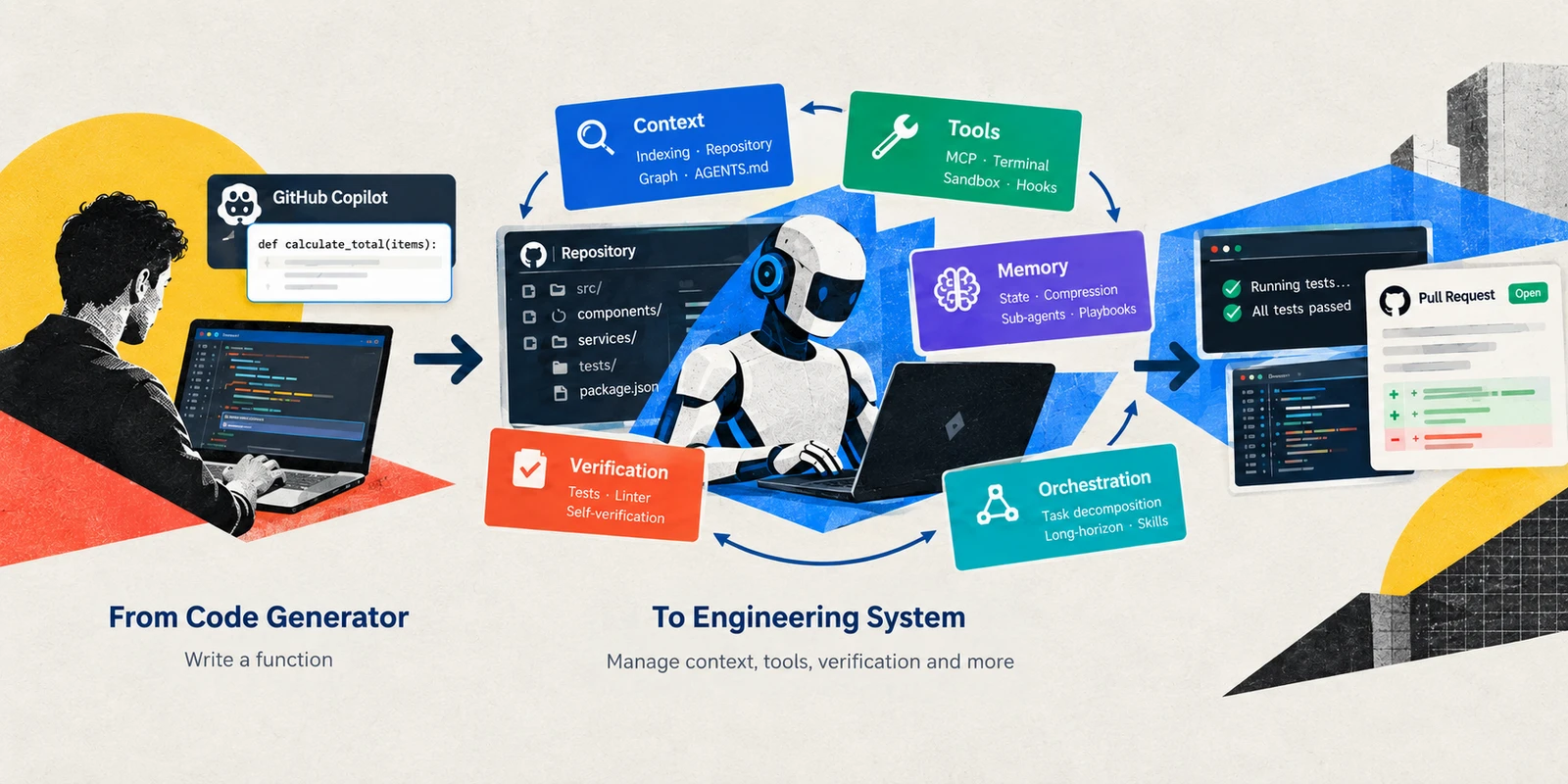
The story everyone tells is simple: early Copilot autocompleted a function; today a coding agent reads your whole repo, edits dozens of files, runs the tests, sees the errors, fixes them, re-runs, and opens a pull request. The trend is "obvious," and it is. But the obvious framing hides the more interesting truth. What changed is not that the model became a better code generator. It is that we surrounded the model with an operating system — context management, tool use, verification loops, memory, and long-horizon orchestration — and that operating system, not the model weights, is now where the real engineering happens.
The Bridge Was Crossed in Public
The institutional crossing of that bridge is easy to date. GitHub Copilot shipped in 2021 as inline completion. In February 2025, GitHub unveiled agent mode and a first look at an autonomous SWE agent codenamed "Project Padawan." On May 19, 2025, at Microsoft Build, the GitHub Copilot coding agent entered public preview: you assign it a GitHub issue, it spins up a secure cloud environment on GitHub Actions, explores the repository, edits files, validates its work with your tests and linter, and pushes a draft PR for you to review. RedMonk's Kate Holterhoff, quoted in GitHub's own announcement, described it as shifting Copilot "from an in-editor assistant to a genuine collaborator in the development process." That sentence is the whole thesis in miniature — the unit of work stopped being a function and became a task.
What "System" Actually Means Technically
The new technical vocabulary — repository context, task decomposition, agent memory, codebase indexing, tool calling, terminal execution, test generation, self-verification, long-horizon management, Agent Skills, sandbox — looks like a list. It is really five subsystems.
Perception: codebase indexing and repository context. This is where the grep-versus-vectors debate lives. Traditional RAG was built for prose, where semantic similarity works. Code is a graph of imports, calls, and types; a chunk calling processPayment() does not necessarily resemble the chunk that defines it. So the agents that actually ship — Claude Code, Cursor, Devin — lean on grep, file trees, and dependency-graph traversal rather than pure vector search, with hybrid retrieval (vector + graph + keyword) winning in practice. On top of that sits a static "onboarding manual": CLAUDE.md, .cursorrules, and by early 2026 the field consolidated on AGENTS.md, an open standard now governed by the Linux Foundation and read by Codex, Claude Code, Cursor, and Copilot alike.
Memory and state: agent memory. The context window is a finite, degrading resource — Chroma's 2025 "Context Rot" study measured output quality falling as input length grew across 18 frontier models, independent of the stated window size. The defenses are now standard primitives: write state to disk, retrieve only what's relevant, compress, and isolate work into sub-agents that return a tight 1,000–2,000 token summary instead of a raw transcript. Research like Stanford and Berkeley's ACE pushes this further, with self-evolving "playbooks" that refine rather than reset.
Action: tool calling, terminal execution, sandbox. The Model Context Protocol turned tool access into a typed, reusable interface; Hooks enforce rules the model would otherwise follow only probabilistically; isolated containers and git worktrees keep a mistake from becoming a catastrophe. The agent no longer suggests — it executes.
Verification: test generation and self-verification. The closed loop of edit → run → read failure → fix → re-run is precisely what separates a "system" from a "generator." Copilot's agent validates with your linter and tests before it ever tags you for review.
Orchestration: task decomposition and long-horizon management. METR's Time Horizon benchmark measures how long an agent can work alone before it fails or asks for help. The 50% horizon went from roughly 39 minutes for o1 (December 2024) to about 12 hours for Claude Opus 4.6 (February 2026) — it has roughly doubled every 4.3 months. That is the quantitative signature of a system, not a spell-checker.
The Benchmark Is the Proof — and the Problem
The proliferation of agent benchmarks that grade real engineering process rather than single code puzzles — SWE-bench, SWE-bench Verified, SWE-bench Pro, Terminal-Bench 2.0, METR Time Horizon, YC-Bench, OTelBench, BinaryAudit — is itself the trend made measurable. We stopped asking "can it write a function" and started asking "can it survive an hour in a real repo."
But here is the insight the cheerleading misses. On February 23, 2026, OpenAI — one of the benchmark's most prominent users — deprecated SWE-bench Verified for frontier evaluation. Its audit found that at least 59.4% of the harder problems it checked had flawed test cases that rejected functionally correct solutions, and that every frontier model it tested could reproduce gold patches from a task ID alone. The much-cited climb from 74.9% to 80.9% over six months, OpenAI concluded, reflected training-data exposure more than capability. Microsoft's separate "Saving SWE-Bench" work found that when tasks were mutated into the informal chat style developers actually use, benchmarks overestimated agent capability by more than 50%.
The honest gap lives in the numbers everyone skips: top models cluster at 70–80%+ on SWE-bench Verified, but scored only around 23% when SWE-bench Pro launched (Scale AI, September 2025), a harder, less-contaminated set of long-horizon, multi-file, multi-language tasks. Codex has since pushed that to 56.8%. The trend is real. The maturity is overstated by the scoreboard we kept quoting.
The Real Shift: An Operating System Around the Model
Andrej Karpathy's metaphor is the cleanest description: the LLM is a CPU, the context window is RAM, and the engineer is the operating system. The move from generator to system is, at its core, a move from "emit tokens" to "manage context, state, tools, and verification across time." Every item on the new technical list — repository context, memory, indexing, decomposition — is a symptom of one root cause: the attention budget is finite and degrades, so you must engineer what the model sees. That discipline, context engineering, is the durable skill; the model was never the bottleneck.
The Economics Flipped Too
When the unit of work became the task, billing followed. Cursor's Background Agents 1.0 (May 2026) is priced in agent-hours, not messages. Claude Code typically spends 3–4× the tokens of Codex on the same task — verbosity that correlates with thoroughness but burns limits faster. A cached token costs about a tenth of an uncached one, so stabilizing the prefix (system prompt, tool definitions) is a 10× cost lever. The "system" does not just behave differently from the "generator"; it is accounted for differently.
Where This Leaves Engineering Teams
For teams adopting these tools, four moves matter. First, invest in AGENTS.md and context engineering — the cheapest, highest-leverage layer. Second, design for the verification loop; an agent that cannot run your tests is a generator wearing a costume. Third, treat public benchmarks as supplementary, not authoritative; measure on your own repository and your own chat-style requests. Fourth, remember the unit of work is now the task spanning hours and multiple repos, not the file. The agent has become a software-engineering system. The open question is whether our evaluation, our economics, and our habits have caught up.
- GitHub. (2025). GitHub Copilot coding agent in public preview. GitHub Blog (Changelog, May 19, 2025).
- GitHub. (2025). GitHub Introduces Coding Agent For GitHub Copilot. GitHub Newsroom (Press Release, Microsoft Build, May 19, 2025).
- GitHub. (2025). GitHub Copilot Introduces Agent Mode and Next Edit Suggestions. GitHub Newsroom (Press Release, Feb 6, 2025).
- OpenAI. (2026). Why SWE-bench Verified no longer measures frontier coding capabilities. OpenAI (Feb 23, 2026).
- Centre for Software Excellence. (2026). Before You Score the Model, Score the Benchmark. Centre for Software Excellence Blog.
- METR. (2026). Time Horizon Benchmark (TH 1.1, HCAST). metr.org.
- Scale AI. (2025). SWE-bench Pro: Long-Horizon Software Engineering Benchmark. arXiv (Sept 21, 2025).
- Chroma. (2025). Context Rot: How Increasing Input Tokens Degrades LLM Performance. Chroma Research.
- Anthropic. (2025). Context Engineering for AI Agents. Anthropic Engineering Blog.
- Wang, S., et al. (2025). ACE: Agentic Context Engineering. arXiv:2510.04618.
- Mindstudio. (2026). Why Cursor, Claude Code, and Devin Use grep, Not Vectors. Mindstudio Blog.
- Dev.to / Corestory. (2026). How to Give AI Coding Agents Better Codebase Context (AGENTS.md, Linux Foundation standard).
- Context Studios. (2026). Context Engineering for Claude in the Enterprise 2026.
- Consumer Tech Wire. (2026). Cursor Ships Background Agents 1.0 With Multi-Repo Awareness (May 15, 2026).
- Context Studios. (2026). AI Coding Agents Showdown: Claude Code vs Cursor vs Codex.
- MorphLLM. (2026). Cursor vs Claude Code vs Codex in 2026.
- CodeSOTA. (2026). Agentic Coding Benchmarks Registry (SWE-bench Verified, Terminal-Bench 2.0, METR, YC-Bench, OTelBench, BinaryAudit).
- Tencent Tech (QQ News). (2026). Claude Code v2.1.261: /skill-doctor and 128K output limits (Sep 7, 2026).