 By
BySmall Models, Big Reasoning Budgets: The New Scaling Frontier
A small model given a large inference budget is closing the gap with far larger models on reasoning tasks — and in some cases beating them. The trend is reshaping how AI capability is bought, built, and deployed, but it comes with three hard limits that practitioners cannot ignore.
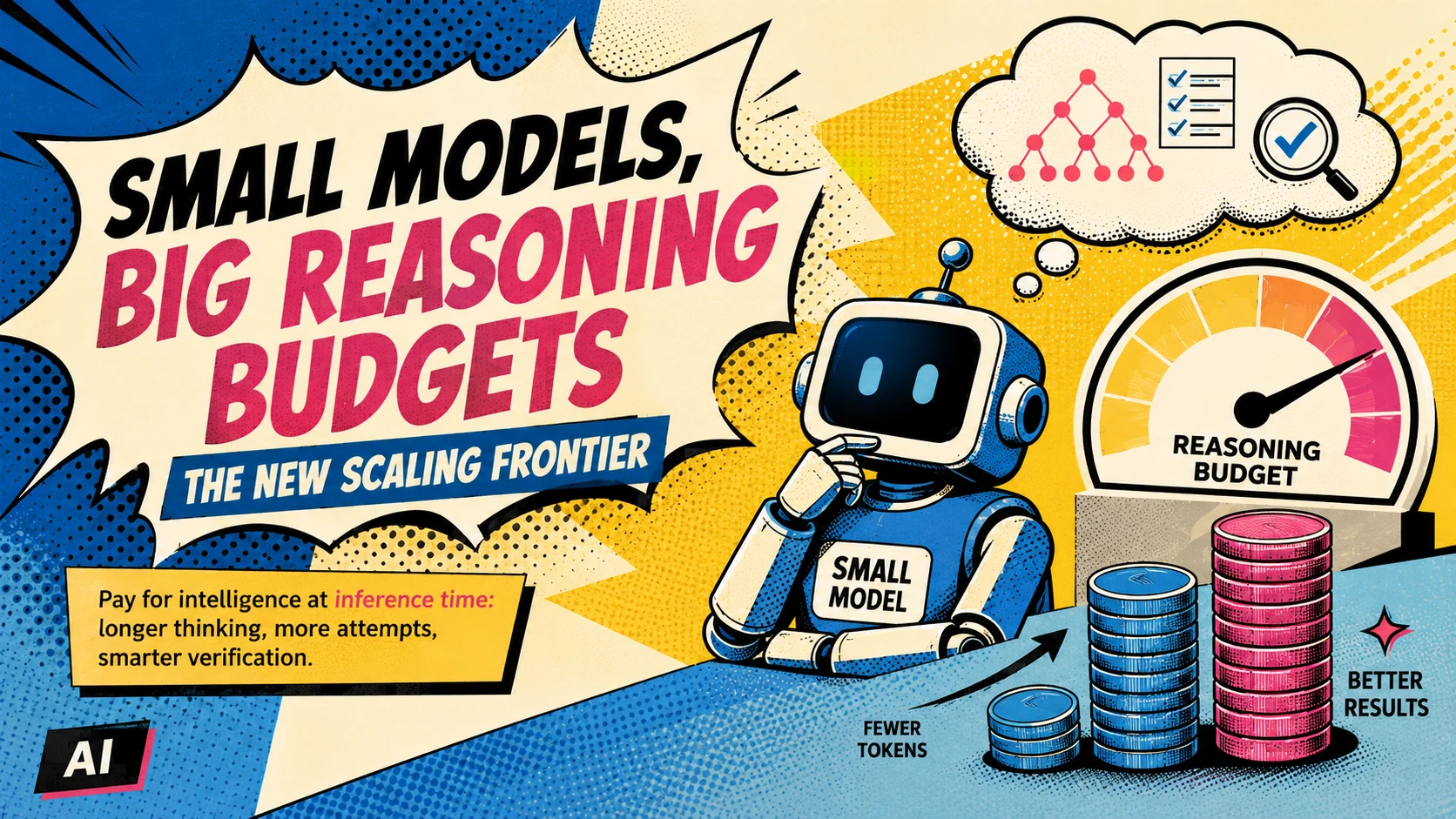
For a decade, the AI industry's unit of ambition was the parameter. Capability meant scale: more weights, more data, more pretraining FLOPs. In 2026, a second lever has matured into a first-class strategy — give a small model a large reasoning budget. Instead of paying for intelligence in parameters, teams are paying for it at inference time: longer chains of thought, parallel sampling with verification, tree search, and adaptive per-request budgets. The direction is now backed by peer-reviewed evidence, shipped products, and a rapidly changing cost curve — and it is quietly rewriting how capability gets purchased.
The evidence: small models, big budgets
The academic foundations were laid in 2024–2025. Snell et al. (ICLR 2025, oral) formalized compute-optimal test-time scaling: given a fixed inference budget, adapting the strategy to each prompt's difficulty improved efficiency by more than 4x over a best-of-N baseline, and in FLOPs-matched evaluations a smaller base model with the right test-time strategy outperformed a model 14 times larger. Wu et al. (2024) showed Llemma-7B paired with tree search consistently beat Llemma-34B on MATH across all tested strategies. Brown et al.'s "Large Language Monkeys" (2024) added the coverage law: the fraction of problems solved by at least one of N samples scales smoothly with log-N, so even a modest base model becomes dangerous when paired with many candidates and a reliable verifier.
The 2025–2026 model generations turned these findings into products. Qwen3-4B rivals the performance of the 72B-class Qwen2.5-Instruct on reasoning tasks, and the MoE variant Qwen3-30B-A3B — which activates only about 3B parameters per token — outperforms QwQ-32B with roughly 10x fewer active parameters. OpenAI's open-weight gpt-oss-20b (~21B total, ~3.6B active per token) runs on a 16GB-memory-class device and exposes explicit reasoning-effort levels: in a 2026 reproducibility study of test-time scaling (arXiv:2608.04001), gpt-oss-20b scored 47.4 at low effort and 64.0 at high effort on a fixed mathematics roster — the budget itself is worth roughly 17 accuracy points, at a fraction of the size of frontier models. The same study's repeated-sampling numbers make the "big budget" effect vivid: Qwen3-4B-Thinking-2507 reached a Pass@80 of 87.5 percent versus 91.7 for models several times its size — a small model with eighty attempts is in the frontier's neighborhood.
The Alan Turing Institute pushed the idea to its practical extreme. In a six-week sprint, researchers fine-tuned a 3B open-weight model on 2,000 reasoning traces distilled from DeepSeek-R1, combined it with retrieval and budget forcing at inference time, and reached near-frontier performance on real-world health triage queries — with a model small enough to run on a laptop.
Why now: the economics flipped
Three curves converged. First, inference cost asymmetry: NVIDIA's position paper "Small Language Models are the Future of Agentic AI" (Belcak et al., 2025) estimates that running a 7B model is roughly 10 to 30 times cheaper than a 70B–175B model — and argues that most agentic workloads are narrow, repetitive tasks where that trade is almost free to make. Second, the price collapse of fixed capability: a16z's "LLMflation" puts it at roughly 10x cheaper per year, and Epoch AI measures a median near 50x per year depending on task. An MMLU score of 42 cost about $60 per million tokens with GPT-3 in late 2021; Llama-3.2-3B delivers it for around $0.06 today. Third, the hardware substrate: NPUs shipping in 2025–2026 phones and Copilot+ PCs, plus mature quantization and MoE architectures, put multi-billion-parameter reasoning models inside consumer devices. Artificial Analysis's March 2026 measurements of Qwen3.5's small reasoning models — a 4B at intelligence index 27 and a 9B at 32 — show the sub-10B tier improving faster than the large-model tier it sits beneath.
The catch: three hard limits
The trend is real, but the honest version has boundaries.
1. The Small Model Learnability Gap. Li et al. (ACL 2025) found that models under 3B parameters often get worse when fine-tuned on long, complex reasoning traces from large teachers — they learn the style of thinking ("Wait," "Let me double-check") without the substance, and drop more than 10 points on MATH and AMC. Their fix, Mix Distillation (about 20 percent long-form traces blended with 80 percent short ones), recovered 8+ points for Qwen2.5-3B. Building a small reasoner is a data-curation problem, not a distillation pipeline you can run blindly.
2. Overthinking. An ACL 2026 Findings study on basic math reasoning found reasoning models generate on average 18x more tokens than standard models — Phi-4-reasoning-plus produced 6,780 tokens against Phi-4's 379, with lower accuracy (69.5 percent vs. 78.9 percent). Constrain a reasoning model's token budget and it can collapse: Qwen3 fell from 72 percent to 44 percent under a 1,024-token cap. Meanwhile, production effort knobs show diminishing returns — moving GPT-5-class models from low to high reasoning effort yields near-zero accuracy gain on the benchmark's tasks. Extra budget helps on hard, verifiable problems; on easy ones it buys nothing and can subtract.
3. Saturation and knowledge breadth. Compute-optimal scaling cuts both ways: at large budgets, bigger models eventually win because small models saturate first. And no inference budget substitutes for missing knowledge — distilled small models shine on math, code, and structured tasks, but still lose on broad, knowledge-heavy benchmarks like GPQA-Diamond.
From choosing a model to choosing a budget
The practical consequence is that model selection is becoming compute-strategy selection. Production systems now expose reasoning effort as a dial (minimal to high), routers decide per request whether to think at all, and verifiers — unit tests, reward models, schema checks — make parallel sampling worth paying for. The winning 2026 deployment pattern is heterogeneous: a 3–9B local model handles the 80–90 percent of agentic steps that are routine — parsing, tool calls, formatting, classification — while only genuinely hard reasoning turns escalate to a frontier cloud model. Routing policy doubles as privacy policy, since teams can decide per task whether content may leave the device at all.
None of this means the frontier no longer matters. Pretraining still sets the ceiling; inference compute determines how cheaply you can approach it, and for a growing share of workloads, how much of the ceiling you actually need. The shift is in where the industry looks for the next efficiency gain: not a bigger file of weights, but a smarter budget for spending thought. Small models with big reasoning budgets won't replace frontier systems — they are becoming the default substrate beneath them.
- Snell, Lee, Xu & Kumar. (2024). Scaling LLM Test-Time Compute Optimally can be More Effective than Scaling Model Parameters. arXiv:2408.03314 / ICLR 2025 (Oral). https://arxiv.org/abs/2408.03314
- Wu et al. (2024). Inference Scaling Laws: An Empirical Analysis of Compute-Optimal Inference for Problem-Solving with Language Models. arXiv:2408.00724. https://arxiv.org/abs/2408.00724
- Brown et al. (2024). Large Language Monkeys: Scaling Inference Compute with Repeated Sampling. arXiv:2407.21787. https://arxiv.org/abs/2407.21787
- Li, Yue, Xu et al. (2025). Small Models Struggle to Learn from Strong Reasoners. ACL 2025 / arXiv:2502.12143. https://arxiv.org/abs/2502.12143
- Belcak et al. (NVIDIA). (2025). Small Language Models are the Future of Agentic AI. arXiv:2506.02153. https://arxiv.org/abs/2506.02153
- Test-Time Scaling in Reasoning LLMs: Inference Regimes, Evaluation, and Reproducibility. (2026). arXiv:2608.04001. https://arxiv.org/html/2608.04001
- Do LLMs Overthink Basic Math Reasoning? Benchmarking the Accuracy-Efficiency Tradeoff in Language Models. (2026). Findings of ACL 2026. https://aclanthology.org/2026.findings-acl.1285.pdf
- The Alan Turing Institute. (2026). Why we still need small language models – even in the age of frontier AI. https://www.turing.ac.uk/blog/why-we-still-need-small-language-models-even-age-frontier-ai
- OpenAI. (2025). gpt-oss-20b / gpt-oss-120b open-weight models. https://openai.com/index/introducing-gpt-oss/
- Alibaba Qwen Team. (2025). Qwen3 Model Family (Qwen3-4B-Thinking-2507, Qwen3-30B-A3B). https://qwen.ai
- FrontierNews.ai. (2026). How AI Labs Are Squeezing Better Reasoning Out of Smaller Models at Test Time. https://www.frontiernews.ai/news/article/how-ai-labs-are-racing-to-make-models-smarter-at-t-8ff88adf
- Artificial Analysis. (2026). Qwen3.5 small-model intelligence index measurements. https://artificialanalysis.ai
- Chandra, V. (2026). On-Device LLMs: State of the Union, 2026. https://v-chandra.github.io/on-device-llms/
- a16z / Epoch AI. (2025). LLMflation: LLM inference cost declining ~10x per year; Epoch AI inference price analysis. https://a16z.com/llmflation-llm-inference-cost/