 By
ByWorld Models Are the New Foundation Models for Physical AI
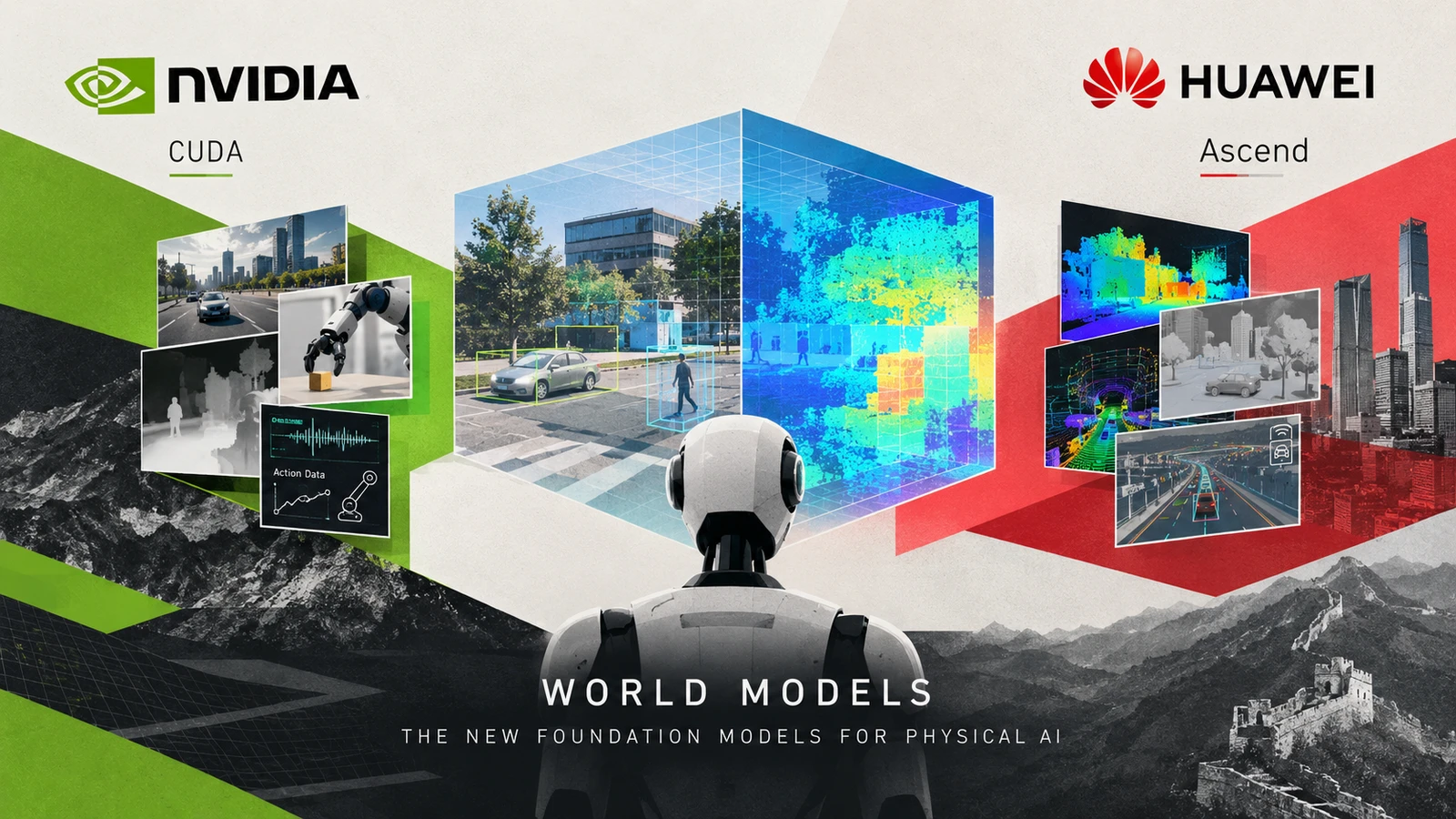
Large language models learned the statistics of text. The next foundation-model frontier learns the dynamics of the physical world — and in 2026 it is being built twice at once, on NVIDIA's CUDA stack and on Huawei's Ascend stack.
For three years, the center of gravity in AI was a single bet: scale a model on the text of the internet, and intelligence follows. That bet produced astonishing language systems. It also produced a strange blind spot — models that can write about a glass falling off a table but have no concept of what a falling glass does. They predict words, not the world.
That limitation is now the explicit target of a fast-converging field. Call it what you like — Physical AI, embodied AI, world models, spatial intelligence — the throughline is the same: build systems that understand space, time, cause and effect well enough to perceive, reason about, and act inside the physical world. The signal this year is not a lone paper. It is a coordinated, multi-billion-dollar pivot — and crucially, it is being assembled on two parallel stacks at once. On the CUDA side, NVIDIA, Google DeepMind, Fei-Fei Li's World Labs, and Yann LeCun's AMI Labs are shipping real artifacts rather than manifestos. On the Ascend side, Huawei has stood up a full-stack counterpart — CloudRobo, MoWorld-3D, and Pangu — that mirrors the same logic on domestic silicon. The two poles are not copying each other; they are independently converging on the identical insight while laying down two incompatible supply chains beneath it.
What "world model" actually means
A world model simulates the dynamics of an environment: given a state and an action, it predicts the next state. Not "what word comes next," but "what happens if the robot closes its gripper on that object" or "what does a pedestrian stepping off the curb do next." NVIDIA frames the epistemological break cleanly: an LLM learns correlations between symbols; a world model learns dynamics — space, time, and cause-effect. A robot cannot merely recognize a chair; it must know the chair can be moved, leaned on, or navigated around, and it needs an internal model of the world to simulate a decision before executing it on hardware.
Practically, world foundation models (WFMs) are used today as a stand-in for reality during training. You train or run a robot or autonomous-vehicle policy inside a WFM-generated simulation, evaluate it across thousands of scenario variations, and only move to physical testing once it is reliable in simulation. The bottleneck they attack is brutal and concrete: collecting enough real-world data is slow, expensive, and — for rare edge cases like a child running into the road or a tire blowout — dangerous or impossible to stage. NVIDIA's GR00T-Dreams blueprint reportedly generated a volume of synthetic robot training data in 36 hours that would take roughly three months to collect by hand. That acceleration, not raw model size, is the prize.
There is a third formulation of "world model" worth naming up front, because it is where Huawei's technical bet sits and it changes how you read the whole field. A world model need not predict the next video frame (the generative school) or the next latent token (the predictive school). It can instead output a structured 3D scene — depth maps, camera pose, and object semantics — that a robot's planner can reason over directly, without ever rendering a pixel. Huawei's MoWorld-3D is the clearest production instance of this 3D-native formulation, and it is the thread that runs through Huawei's entire Physical AI stack.
NVIDIA's Cosmos 3: the CUDA-pole flagship
The clearest statement of the generative direction is NVIDIA Cosmos 3, announced June 1, 2026 at GTC Taipei (Computex). It is the first fully open omnimodel for Physical AI — and "omnimodel" is the precise word. Where Cosmos 2.5 and 2 kept perception and generation as separate models limited to text, image, and video, Cosmos 3 collapses them into one system that natively generates *text, image, video, ambient sound, and robot action data*** — joint angles, gripper positions, trajectory waypoints. A robot needs motor commands, not pixels; Cosmos 3 produces both.
Architecturally it uses a Mixture-of-Transformers (MoT): an autoregressive Reasoner tower that builds a structured internal representation of the scene first, then a diffusion-based Generator tower that produces outputs conditioned on that representation. The design enforces reasoning before acting, which NVIDIA argues prevents the failure mode where a generative model emits physically implausible output — the known weakness of earlier world models. Two sizes ship: Nano (16B, runs on an RTX PRO 6000 workstation for real-time robotics inference) and Super (64B, for datacenter synthetic-data generation and policy post-training). It is released under the OpenMDW 1.1 license (a Linux Foundation model license) with weights on Hugging Face, code and training recipes on GitHub, and NIM microservices through Azure, CoreWeave, and others. NVIDIA also launched the Cosmos Coalition — Agile Robots, Black Forest Labs, Runway, Skild AI, and others — to build a production ecosystem around it from day one.
The caveat worth stating plainly: NVIDIA reports Cosmos 3 as #1 among open models across every benchmark it entered (Physics-IQ, PAI-Bench, R-Bench, RoboLab, RoboArena, VANTAGE-Bench, TAR). Those rankings are self-reported at launch; independent replication will take time.
Huawei's CloudRobo + MoWorld-3D: the Ascend-pole flagship
If Cosmos 3 is the generative-video, CUDA-native flagship, Huawei's answer is the 3D-native, Ascend-native flagship — and it is built on a deliberately different technical thesis. Huawei is explicitly not building robots; it is building the infrastructure layer those robots train and run on. At WAIC 2026 (July), Huawei Cloud launched CloudRobo, a full-stack embodied-AI development platform spanning data production, model development, simulation, and robot deployment, with a domestic Real-Sim evaluation system and 20+ robotics partners (including Youibot and Huayan Robotics).
The technically distinctive piece is MoWorld-3D, released with the National Embodied Intelligence Application Pilot Base and Moxin (魔芯) Technology and described by state outlets (China Net, Xinhua) as the first 3D world model built entirely on domestic Ascend (昇腾) NPUs. Where Cosmos 3 predicts video and action, MoWorld-3D performs "4D spatial modeling": rather than emitting a video clip, it outputs a complete 3D model of the scene with depth, camera pose, and object semantics. That is a different production philosophy. A robot planner does not need a photorealistic render; it needs a manipulable spatial representation it can reason over — and MoWorld-3D delivers exactly that, at the edge of real time. Credible reporting states it sustains roughly two minutes of scene memory, supports 1080p real-time interaction with 6-degree-of-freedom camera control, and — the detail that matters most for adoption — reaches up to 50 FPS real-time inference at roughly 30% of the cost of an equivalent GPU deployment, because the entire training and inference pipeline runs on Ascend silicon. (Reported parameter counts differ across outlets — one cites ~14B, another ~28B — so we treat it as a multi-billion-parameter MoE and anchor on the verifiable capability figures instead.)
Huawei's Pangu multimodal model extends the same logic to autonomous driving: from a single image it generates a high-precision digital-physical space, predicts collisions, and produces driving video and LiDAR point clouds that reportedly helped Huawei's ADS end-to-end model ship "a version every two days." CloudRobo + MoWorld-3D + Pangu form a vertical stack whose throughline is identical to NVIDIA's — lower the cost of the data-and-simulation loop, and the ecosystem forms around your compute — but whose substrate, simulator, and model family are entirely Huawei's own.
The ecosystems are already real — on both stacks
This is not a demo on either side. On the CUDA pole, robotics and AV leaders are already building on Cosmos and the Omniverse/Isaac stack: Boston Dynamics, Figure AI, Skild AI, Serve Robotics, Zipline, Uber, and Magna. Serve Robotics has completed 100,000+ last-mile deliveries and feeds its simulator ~170 billion image-LiDAR samples per month. At CES 2026, NVIDIA extended the thesis to driving with Alpamayo, an open-weight family of autonomous-driving models (plus AlpaSim, an open-source AV simulator, and a 1,700+ hour open driving dataset). On the Ascend pole, Huawei's CloudRobo has already aggregated 20+ robotics partners and its Pangu-driven ADS iteration cadence shows the same simulation-first loop in production. The pattern across both stacks is the same: synthetic data and simulation-first training close the gap between "works in the lab" and "works on the street." What differs is which compute, which simulator, and which partner ecosystem you are locked into.
Insight 1: The bottleneck has moved from "model" to "the world-grounded data + simulation loop"
The hard problem in Physical AI was never architecture. It is that real-world data is slow, costly, and risky to collect, and policies trained in simulation do not automatically transfer to reality (the classic sim-to-real gap). World models attack exactly this — and in doing so, they shift the scarce resource. The defensible moat is no longer raw model scale; it is the closed loop of curation → simulation → policy training → verification, wrapped around the model. And this moat now exists in two instantiations: NVIDIA's vertical stack (Omniverse for simulation, Cosmos for world models, Isaac for robotics learning, DGX to train, AGX to deploy) and Huawei's parallel stack (CloudRobo for the dev-and-sim platform, MoWorld-3D for the world model, CANN + Ascend as the compute substrate). Whoever owns the data-and-simulation loop owns the agent — the same lesson the multimodal-agent shift taught us a year ago, now playing out on two incompatible supply chains at once.
Insight 2: World models are becoming a new infrastructure layer — and both giants are playing the substrate game
Notice the strategy on both sides. NVIDIA is not trying to be the "OpenAI of the physical world" by hoarding a closed frontier model. It open-sources Cosmos 3 — weights, code, datasets, training recipes — and stands up a coalition, exactly as it won AI training by owning the substrate (CUDA) rather than the applications. The 16B Nano model is free, fine-tunable on custom robot demonstrations, and runs on a single workstation. Huawei is running the same playbook on Ascend: open the CloudRobo platform and the MoWorld-3D model to a domestic partner ecosystem rather than selling finished robots, owning the substrate (CANN, the Ascend operator library that is the literal counterpart to CUDA) instead of the applications. This is a land-grab for the "operating system of Physical AI" on two continents simultaneously: lower the barrier so the ecosystem forms around your stack, then monetize the compute and the platform. The foundation-model business is bifurcating — language intelligence and physical-world intelligence are becoming two distinct infrastructure layers — and two different giants are each racing to own the second one.
Insight 3: "Action output" is what turns a world model into an omnimodel — and both poles collapse the stack
The decisive detail in Cosmos 3 is that it emits action vectors, not just video. That single choice reframes the unit of value from "modality coverage" to "agency in the physical world." What used to require stitching three models — a vision-language model, a world model, and a separate policy network — now lives in one forward pass, with reasoning enforced before generation. Huawei's Pangu-for-AV shows the same collapse from the other direction: a single multimodal model that perceives the scene, predicts collisions, and produces driving video and point clouds — perceive, predict, and act compressed into one system. This is the same "stack collapses from framework to model" pattern seen in native agent models like UI-TARS: capability that was orchestration engineering moves into the weights. The robot equivalent of "the agent that clicks" is "the model that closes the loop of See → Simulate → Act" — and both the CUDA pole and the Ascend pole have now demonstrated it.
Insight 4: The field splits into three formulations — and the split is a use-case split, not a doctrine war
There are genuinely different architectures, and the difference is not cosmetic. Generative-video world models — World Labs' Marble, NVIDIA's Cosmos, Google DeepMind's Genie 3 — render photorealistic, navigable worlds; the output is the product (synthetic data, explorable environments). Latent/predictive models — LeCun's AMI Labs using JEPA (Joint Embedding Predictive Architecture) — deliberately do not generate pixels; they predict in compressed representation space, because for a robot the relevant output is a decision, and rendering is waste. And now a third, 3D-native formulation — Huawei's MoWorld-3D, and World Labs' spatial work — outputs a structured 3D scene (depth, pose, semantics) rather than video or tokens, optimized to be consumed directly by a machine planner. All three call themselves "world models." The resolution is pragmatic: build a world for humans to see and create with → use the generative school; build a world for a machine to plan inside → use the latent or 3D-native school. They are complementary infrastructure, and smart builders will pick by use case rather than allegiance — which, on the ground, now also means picking a compute camp.
Insight 5: A world model is a simulator, not a substitute for reality — and evaluation is the unsolved problem
The hype risk is treating "the model generated a plausible video of a robot succeeding" as "the robot can succeed." Three honest limits remain, and they bite both poles. (1) Temporal consistency: even the best models drift after a few minutes — geometry warps, objects forget they existed. "Consistent for minutes" is the frontier, not "forever." (2) Hallucinated physics: learned-from-watching physics is approximate. It looks right far more often than it is right — dangerous if trusted blindly for safety-critical training. (3) Evaluation is unsolved: "did the simulation behave like reality?" is much harder to score than a benchmark answer, and the sim-to-real gap is still real. So 2026 is the year world models became usable tools, not the year they solved Physical AI — whether the world model runs on CUDA or on Ascend. The deployment gate is trust and evaluation, not capability — the same throughline as last year's agent shift.
Insight 6: The stack is bifurcating along compute-sovereignty lines, and that fork may outlast the technical ones
Here is the part pure-technical coverage misses. The two infrastructure plays — NVIDIA's Cosmos/Omniverse/Isaac on CUDA, and Huawei's CloudRobo/MoWorld-3D/Pangu on Ascend — are not competing on model cleverness alone. They are two complete, sovereign stacks: different chips, different operators (CUDA vs CANN), different simulators, different model families, different partner ecosystems. The generative-vs-latent-vs-3D-native split (Insight 4) is a technical fork; the CUDA-vs-Ascend split is a geopolitical fork, and it may prove more durable. For builders, this means the "open world model you can pick up" in 2026 is increasingly tied to a compute allegiance: Hugging Face weights that assume CUDA, or a Huawei Cloud service that assumes Ascend. The foundation-model business is not just bifurcating into language vs physical (Insight 2) — it is also splitting into two incompatible physical-AI supply chains. Whoever sets the default stack in a given region captures the training loops of every robot and AV built there. We may look back on 2026 as the year the physical-AI world model was built twice, in parallel, and the two versions stopped talking to each other.
The throughline
The phrase "foundation model" is being quietly rewritten. For a decade it meant "a big model trained on the internet's text." The 2026 revision adds a second pillar: a model trained on the dynamics of the physical world — one that can simulate what happens next and act on it. The actors converged independently because the limitation of symbol-only intelligence finally became impossible to ignore. We are not waiting for a smarter chatbot. We are watching a new infrastructure layer assemble — open world models, simulation-first training loops, and a split-but-complementary set of architectures for seeing, planning, and acting. That layer is assembling twice over, on CUDA and on Ascend, and the two stacks may not converge. The models that understand the world — not just describe it — are already shipping on both poles. The next eighteen months are about whether we can trust what they simulate, and which stack we end up building on.
- NVIDIA. (2026). NVIDIA Cosmos: A World Foundation Model Platform for Physical AI. NVIDIA Developer. https://developer.nvidia.com/cosmos
- NVIDIA. (2026, June 1). NVIDIA launches Cosmos 3 at GTC Taipei (Computex). NVIDIA Newsroom. https://nvidianews.nvidia.com
- NVIDIA. (2026, March 13). Scale Synthetic Data and Physical AI Reasoning with NVIDIA Cosmos World Foundation Models. NVIDIA Developer Blog. https://developer.nvidia.com/blog/scale-synthetic-data-and-physical-ai-reasoning-with-nvidia-cosmos-world-foundation-models
- NVIDIA. (2025, August 11). NVIDIA Opens Portals to World of Robotics with New Omniverse Libraries, Cosmos Physical AI Models. NVIDIA Blog. https://blogs.nvidia.com
- Encord. (2026). Best Foundation Models for the Physical World in 2026: Cosmos, GR00T, and What's Next. Encord Blog. https://encord.com/blog/foundation-models-physical-ai-2026
- Google DeepMind. (2026). Genie 3 and Project Genie: Experimenting with Infinite, Interactive Worlds. Google DeepMind. https://deepmind.google/genie ; https://deepmind.google/blog/project-genie-experimenting-with-infinite-interactive-worlds
- StartupHub.ai. (2026, August 5). Fei-Fei Li's $5B World Labs and the Spatial AI Race No One Agrees On. https://www.startuphub.ai
- Singularity.kiwi. (2026). Three Titans Pivot Away from LLMs: LeCun, Musk, and Fei-Fei Li Bet on World Models. https://singularity.kiwi/lecun-musk-world-models-pivot
- Il Sole 24 Ore. (2026). CES 2026: Nvidia launches Alpamayo, a family of AI models for autonomous driving. https://en.ilsole24ore.com
- AgentFlow Academy. (2026). World Foundation Models Explained: How AI Learns to Simulate Reality. https://agentflow.academy/blog/world-foundation-models
- Li, F. (2026). From Words to Worlds: Spatial Intelligence Is AI's Next Frontier. World Labs / Substack.
- LeCun, Y., et al. (2026, March 23). LeWorldModel (LeWM): A Joint-Embedding Predictive Architecture. AMI Labs.
- Huawei. (2026, July). 国地中心联合华为发布具身智能实训场样板点 (National Center & Huawei launch embodied-AI training-ground pilot). Huawei Enterprise. https://e.huawei.com/cn/news/2026/industries/manufacturing/national-geographic-center
- China Net (中国网). (2026, July 20). 国家具身智能应用中试基地发布全球首个全栈国产NPU三维世界模型 (National pilot base releases first full-stack domestic-NPU 3D world model, MoWorld-3D). http://dicn.china.com.cn/2026-07/20/content_43463910.shtml
- Xinhua (新华网). (2026, August 6). MoWorld-3D世界模型发布,打通AI从"对话交互"到"物理交互"的关键一步. https://www.news.cn/info/20260806/0331f633fba44b58b6d412711c8ebfee/c.html
- Pandaily. (2026, July). WAIC Observation: Huawei Enters Embodied AI With CloudRobo Platform. https://pandaily.com/huawei-cloudrobo-embodied-ai-platform-jul2026