 By
ByFrom Model Power to Context Engineering: The Agent Battleground
For three years the AI scoreboard rewarded bigger models and higher benchmarks. The agent era's real moat is now context engineering — what the model sees at inference time, not the weights inside it.
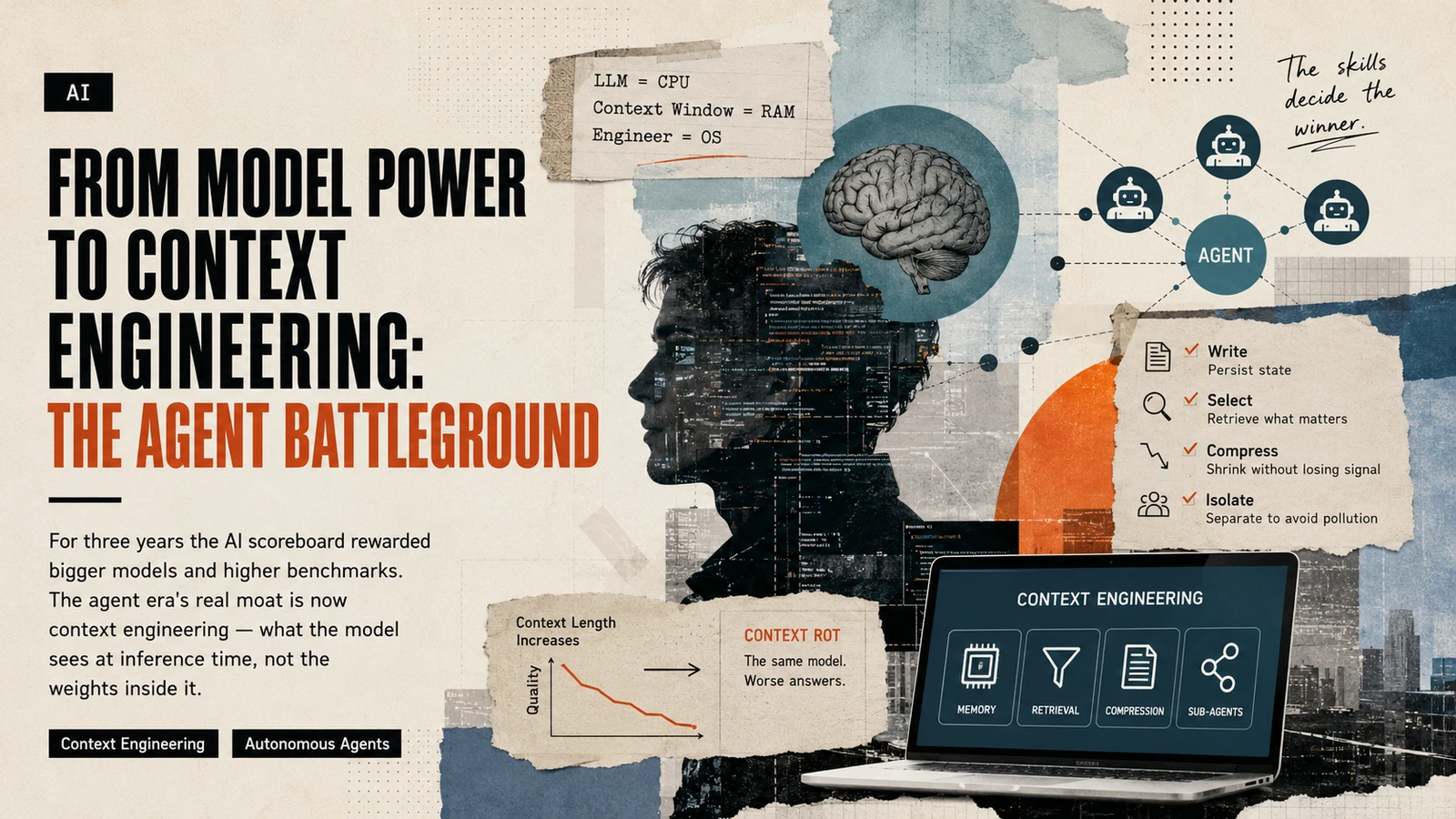
For three years, the AI industry's scoreboard was simple: bigger models, higher benchmarks, more parameters. That scoreboard is now misleading. The competitive frontier for autonomous agents has quietly moved from raw model capability to what engineers are increasingly calling Context Engineering — the deliberate design of everything an LLM sees at inference time.
The phrase entered the mainstream in June 2025, when Shopify CEO Tobi Lutke and Andrej Karpathy independently described it as the defining skill of the agent era. Karpathy's framing was the most quotable: the LLM is a CPU, the context window is RAM, and the engineer is the operating system. If the model is the processor, then whoever manages its memory and I/O best wins — regardless of which chip is inside.
Why Context, Not Capability, Is the Bottleneck
The naive assumption is that a more capable model simply needs more tokens. Reality is crueler. Every token an LLM processes consumes a slice of a finite attention budget, and that budget degrades with length. Because attention is computed as pairwise relationships across all tokens (an O(n²) cost), and because models are trained predominantly on shorter sequences, performance falls as context grows — even well inside the advertised window.
This was quantified in July 2025 by Chroma's "Context Rot" study, which tested 18 frontier models — GPT, Claude, Gemini, and Qwen families — and found that output quality degraded measurably as input length increased, independent of the model's stated context window. This is distinct from two better-known failure modes: context-window overflow (running out of room) and "lost-in-the-middle" (inability to attend to central tokens). Context rot is subtler: the same model, same window, just worse answers as the prompt gets longer.
Drew Breunig, writing with Elastic, later catalogued four operational failure modes that context engineering must defend against: Context Poisoning (corrupt or malicious tokens steer behavior), Context Distraction (irrelevant tokens crowd out what matters), Context Confusion (overlapping or contradictory instructions), and Context Clash (multiple agents write conflicting state). Together these explain why a powerful model given a messy context can underperform a weaker model given a clean one.
Anthropic's Operating Manual
Anthropic has been the most systematic publisher on the topic. Its guidance reduces context engineering to four primitive operations: Write (persist state externally so it survives beyond the window), Select (retrieve only what's relevant from memory), Compress (shrink tokens without losing signal), and Isolate (use sub-agents so independent tasks don't pollute a shared context).
For long-horizon tasks — agents that run for minutes or hours across many steps — Anthropic recommends three techniques: Compaction (summarize progress and re-initialize the context to reset the attention budget), Structured Note-Taking (an external artifact like a todo.md the agent updates continuously, moving memory out of the window), and Sub-Agent Architectures (delegate, then fold back a tight 1,000–2,000 token summary rather than the raw transcript).
Lessons from Production: Manus and MCP
Manus, the general-purpose agent, distilled six hard-won lessons in July 2025. The most economically important: design around the KV-cache. A cached token costs roughly one-tenth of an uncached token, so stabilizing the prefix (system prompt, tool definitions) is a 10× cost lever. Other lessons: Mask, don't remove tools via logit masking rather than dynamically rewriting the tool list (which busts the cache); treat the file system as context (write intermediate state to disk); use recitation to keep attention anchored; keep the wrong stuff in so the model can learn from failures; and don't get few-shotted — control prompt diversity so the model doesn't collapse toward a narrow pattern.
The Model Context Protocol (MCP) became a victim of its own success: turning on many servers meant stuffing the context with every tool's schema. The 2026 fixes are converging: Anthropic's Tool Search (load tool definitions on demand, ~85% token reduction, shipped November 2025), Code Execution / Code Mode sandboxes (Cloudflare ~99.9%, Anthropic ~98.7% reduction by emitting executable code instead of inline tool schemas), and Progressive Disclosure / Agent Skills (scan ~100 tokens of metadata, expand only what's needed). Microsoft's Agent Framework adopted progressive MCP disclosure in July 2026.
Self-Improving Context: ACE
A research frontier is making the context itself adaptive. Stanford, SambaNova, and UC Berkeley's ACE (Agentic Context Engineering), arXiv 2510.04618, replaces static prompts with evolving "playbooks" maintained by a Generator/Reflector/Curator loop. Incremental delta updates let the context grow-and-refine rather than reset — avoiding both brevity bias and context collapse. Reported gains: +10.6% on agent benchmarks, +8.6% on finance tasks, with an 86.9% cost reduction versus naive replay.
The Scaling Caveat
More agents is not automatically better. Google and MIT's "Towards a Science of Scaling Agent Systems" (arXiv 2512.08296), spanning 180 configurations across 5 architectures and 3 model families, found parallel task decomposition improves success by ~80.9%, but sequential dependencies degrade it by 39%–70% as errors amplify down the chain (17.2× amplification under independent routing vs 4.4× under centralized control). Single agents achieved 67 tasks per 1,000 tokens versus 21 for centralized multi-agent systems. The lesson: context engineering determines whether scaling helps or hurts.
The New Job Title
The shift has a human consequence. "Prompt engineer" as a standalone role is giving way to the Context Engineer — the person who designs memory, retrieval, compression, and sub-agent boundaries. The failure statistics are sobering and worth internalizing: enterprises report roughly 65% of agent failures trace to context drift, 88% of production agents die in deployment, and pilot-to-production success rates fall from ~78% to ~11%. The model was never the problem; the context was.
Where This Leaves the Field
Jeff Dean, former Google AI chief, has argued that model capability is increasingly a commodity. Satya Nadella has said much the same about foundational models. Gartner projects that by the end of 2026, 40% of enterprise applications will embed autonomous agents. When models are interchangeable and agents are everywhere, the durable competitive moat is not the weights — it's the engineering of what you feed the weights. Context engineering is that moat.
- Anthropic. (2025). Context Engineering for AI Agents. Anthropic Engineering Blog.
- Chroma. (2025). Context Rot: How Increasing Input Tokens Degrades LLM Performance. Chroma Research.
- Breunig, Drew. (2025). How Long Contexts Fail: Poisoning, Distraction, Confusion, Clash. Elastic Blog.
- Manus. (2025). Engineering Lessons from Building a General-Purpose Agent. Manus Engineering.
- Wang, S., et al. (2025). ACE: Agentic Context Engineering. arXiv:2510.04618.
- Google & MIT. (2025). Towards a Science of Scaling Agent Systems. arXiv:2512.08296.
- Anthropic. (2025). Tool Search for the Model Context Protocol. Anthropic.
- Cloudflare. (2026). Code Mode Sandbox for Agents. Cloudflare Blog.
- Microsoft. (2026). Progressive MCP Disclosure in the Agent Framework. Microsoft.
- Karpathy, Andrej & Lutke, Tobi. (2025). On Context Engineering. Public Commentary.
- Dean, Jeff. (2025). On Model Commoditization. Public Commentary.
- Nadella, Satya. (2025). On Foundational Models as Commodity. Public Commentary.
- Gartner. (2026). Forecast: 40% of Enterprise Applications to Embed Autonomous Agents by 2026. Gartner Research.