 By
ByFrom “Think Longer” to Inference Architecture: How Test-Time Scaling Is Evolving
Inference-time scaling has outgrown its origin as a prompt-level trick for "longer thinking" and is now becoming the organizing architecture of how modern AI systems reason. This article traces that shift from research finding to production system, and what it means for builders.
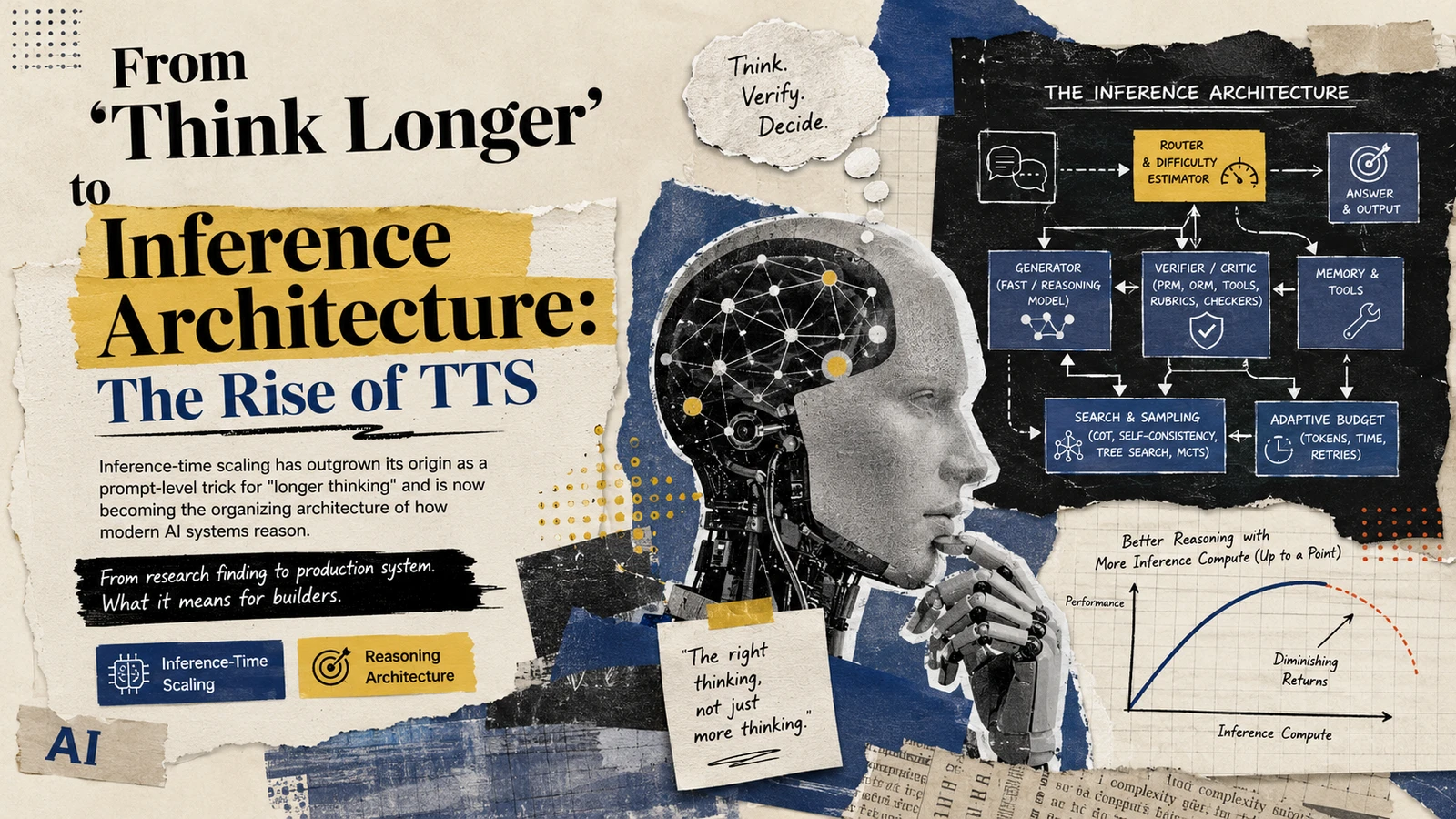
For most of the last decade, "scaling" meant one thing in AI: make the model bigger, train it on more data, spend more FLOPs in pretraining. Inference was treated as a fixed, near-trivial cost — you prompted a model and it answered. That mental model is now obsolete. Over the past two years a different axis of scaling has moved from a research curiosity to the center of how leading AI systems are built: inference-time scaling — spending more computation at inference to make a fixed model reason better. What began as the deceptively simple idea of "let the model think longer" has matured into a full inference architecture: a system of routers, generators, verifiers, search loops, and adaptive budgets that decides, per request, how much and what kind of thinking is worth paying for.
The origin story: thinking as compute
The roots are modest. Chain-of-thought prompting (Wei et al., 2022) showed that asking a model to produce intermediate steps before a final answer improved performance on arithmetic and reasoning tasks. Self-consistency (Wang et al., 2022) went further: sample several reasoning paths and take the majority answer. These were prompting techniques, not architecture. The conceptual leap came in 2024, when two lines of work reframed inference compute as a first-class, controllable resource.
OpenAI's o1 (September 2024) and DeepSeek's R1 (January 2025) turned "thinking" into a visible product capability: the model generates a long, often hidden chain of thought — sometimes thousands of tokens — exploring, planning, backtracking, and self-verifying before it answers. The popular summary was "let it think longer." But behind that slogan sat rigorous research showing the lever was more subtle than "more tokens = better."
What the research actually established
Snell, Lee, Xu, and Kumar (2024) asked a precise question: given a fixed inference budget, how should you spend it? Their answer — a "compute-optimal" strategy that adapts the inference method to each prompt's difficulty — improved efficiency by more than 4x over a best-of-N baseline, and in FLOPs-matched evaluations a smaller base model equipped with optimal test-time compute outperformed a model 14 times larger. The two mechanisms they identified were:
- Search against process-based verifier reward models (PRMs) — generate candidates and score each reasoning step to select the best.
- Adaptive distribution updating — update the model's response distribution per prompt, given the specific input.
Critically, they found no single strategy wins everywhere: easy problems need little extra compute; very hard problems where the base model can almost never produce a correct candidate see diminishing or zero returns.
Concurrent work sharpened the point:
- Wu et al. (2024) showed that Llemma-7B paired with tree search consistently beat Llemma-34B across all strategies on MATH, demonstrating Pareto-optimal cost-performance from advanced inference.
- Brown et al. (2024), in "Large Language Monkeys," showed that coverage — the fraction of problems solved by at least one of N samples — scales smoothly with log-N, so even a weak base model becomes competitive when paired with many candidates and a reliable verifier.
The unifying lesson: training compute sets a model's ceiling; inference compute determines how close it gets.
From one axis to a four-dimensional design space
Once researchers stepped back, it became clear that "think longer" is only one dimension of a much larger space. The 2025 survey "A Survey on Test-Time Scaling in Large Language Models" (Zhang, Lü et al., arXiv:2503.24235) organized the field with a four-dimensional, orthogonal framework:
| Dimension | Question | Examples |
|---|---|---|
| What to scale | What gets expanded? | Parallel, sequential, hybrid, internal computation |
| How to scale | How is it expanded? | Stimulation, verification, search, aggregation; SFT / RL |
| Where to scale | On which tasks? | Math, code, open-ended QA, multimodal |
| How well to scale | How is it measured? | Accuracy, efficiency, controllability, scalability |
This framing exposed the real leverage: not "more thinking," but the right combination — for example parallel sampling plus verifier reranking plus a difficulty-aware adaptive budget.
The decisive turn: inference as a system
The most important shift of 2025–2026 is the recognition that inference-time scaling is not a prompt trick but a systems engineering problem. "Are We Scaling the Right Thing? A System Perspective on Test-Time Scaling" makes the blunt argument that compute-optimal is not system-optimal. In real deployments, latency, cost-per-token, memory, and hardware heterogeneity dominate. Their measurements are counterintuitive: naive tensor parallelism of a 14B reasoning model across four GPUs yielded only a 1.7x latency improvement, because long-sequence reasoning is bottlenecked by intra-GPU synchronization rather than batch size. Speculative decoding helped latency more than tensor parallelism helped cost. The optimal algorithm under a token budget can be the wrong choice under a wall-clock or per-dollar budget.
So modern inference is no longer a single forward pass. It is a composed architecture with distinct components:
- Difficulty estimator / router — decides whether and how much to think.
- Generator — a fast model or a dedicated reasoning model.
- Verifier / critic — process reward models, outcome reward models, unit-test runners, type checkers, schema and retrieval checkers, rubric-guided verifiers.
- Search & sampling controller — self-consistency, tree search, MCTS, particle-based Monte Carlo.
- Adaptive budget controller — caps on reasoning tokens, wall-clock, and retries.
- Memory & tool execution — increasingly central to agentic workflows.
Reasoning tokens have become an observable, billable resource — OpenAI exposes them in its usage object, and they occupy context and cost. The "thinking budget" is now part of the service-level agreement.
GPT-5 (August 2025) is the clearest product expression of this architecture: a unified system pairing a fast, efficient model with a deeper reasoning model (GPT-5 thinking) and a real-time router trained on real signals — model switches, preference rates, measured correctness. By 2026 the separate "reasoning model" product line had largely collapsed into general-purpose models that decide for themselves whether and how long to think, controlled by an effort or level parameter, with tool calls moved inside the reasoning trace and the raw trace hidden from users. The question is no longer "which model," but "how much thinking to authorize."
Verification: the missing half
"Think longer" is not automatically "think better." Longer reasoning can produce overthinking — wandering, spurious steps, and confidently rationalized wrong answers. Several 2025 studies found plateaus and even degradation as thinking budgets grew. This is why the 2026 playbook pairs inference compute with verification:
- T³RL (Stanford and TU Munich) shows that majority voting in test-time RL can create a "false consensus" that reinforces confidently wrong answers; injecting external tool verification and upweighting verified rollouts produced a 31.6% relative improvement on AIME 2024.
- Wan et al. (ACL Findings 2026) introduce "inference-time scaling of verification" via DeepVerifier, a plug-and-play rubric-guided verifier built from an automatic failure taxonomy; it lifts accuracy 8–11% on hard GAIA and XBench subsets and beats LLM-judge baselines by 12–48% F1.
Verification itself can be scaled at inference time, and verifiers are becoming first-class models whose versioning, calibration, and drift demand the same care as embedding models today.
What builders should take away
For teams adopting this architecture, the practical lessons are consistent across the literature:
1. Don't begin with MCTS; begin with task tiering — route only high-value, verifiable requests to heavier strategies.
2. Define hard budgets and soft stopping conditions — consensus reached, marginal verifier gain tiny, tool feedback clearly negative.
3. Treat the verifier as an independent product surface — with offline suites, online sampling, calibration curves, and rollback.
4. Instrument inference telemetry — base model, sample count, reasoning-token count, verifier score, chosen strategy, and whether tools or human review were triggered. Without it you cannot tell whether "more thinking" improved quality or merely made errors more expensive.
5. Benchmark on latency and cost, not just accuracy and FLOPs — because compute-optimal and system-optimal diverge in production.
Inference-time scaling began as the intuition that a model could "think longer." It has become the architecture that decides, per problem, how a system should think at all. That is no longer a prompting technique — it is the operating system of modern reasoning.
- Snell, C., Lee, J., Xu, K., & Kumar, A. (2024). Scaling LLM Test-Time Compute Optimally Can Be More Effective than Scaling Model Parameters. arXiv:2408.03314.
- Wu, Y., Sun, Z., Li, S., Welleck, S., & Yang, Y. (2024). Inference Scaling Laws: An Empirical Analysis of Compute-Optimal Inference for LLM Problem-Solving. arXiv:2408.00724.
- Brown, B., et al. (2024). Large Language Monkeys: Scaling Inference Compute with Repeated Sampling. Stanford Technical Report.
- OpenAI. (2024). Learning to Reason with LLMs. OpenAI Technical Report.
- DeepSeek-AI. (2025). DeepSeek-R1: Incentivizing Reasoning Capability in LLMs via Reinforcement Learning. arXiv:2501.12948.
- Zhang, Q., Lü, F., et al. (2025). A Survey on Test-Time Scaling in Large Language Models: What, How, Where, and How Well. arXiv:2503.24235.
- Are We Scaling the Right Thing? A System Perspective on Test-Time Scaling. (2025). Preprint.
- Wang, J. (2025). A Tutorial on LLM Reasoning: Relevant Methods behind ChatGPT o1. arXiv:2502.10867.
- OpenAI. (2025). Introducing GPT-5. OpenAI.
- T³RL: Tool Verification for Test-Time Reinforcement Learning. (2025). Stanford & Technical University of Munich.
- Wan, Y., Fang, T., Li, Z., Huo, Y., Wang, W., Mi, H., Yu, D., & Lyu, M. R. (2026). Inference-Time Scaling of Verification: Self-Evolving Deep Research Agents via Test-Time Rubric-Guided Verification. ACL Findings 2026, arXiv:2601.15808.
- Han, Y., Ma, F., Quan, R., & Yang, Y. (2025). Dynamic Experts Search: Enhancing Reasoning in Mixture-of-Experts LLMs at Test Time. arXiv:2509.22572.