 By
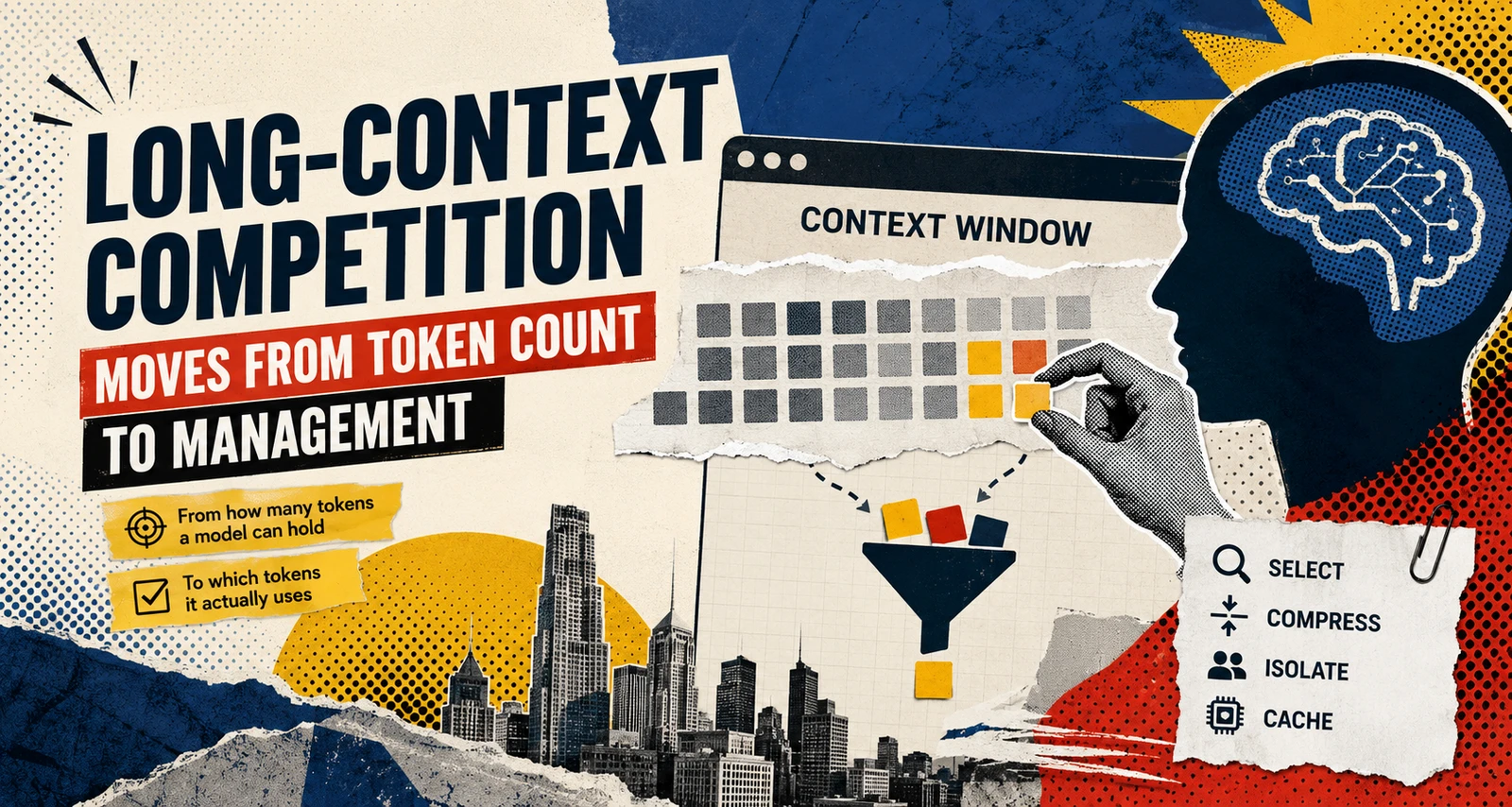
ByLong-Context Competition Moves From Token Count to Management
For three years the benchmark was simple: who ships the biggest context window. The frontier has quietly moved from how many tokens a model can hold to which tokens it actually uses — and that shift is rewriting how production AI gets built.
For most of the last three years, the long-context story was a pure arms race measured in a single number. Google's Gemini 1.5 opened the door to a 1-million-token window, and Gemini 2.0 Pro pushed the ceiling to 2 million. Anthropic's Claude settled at 200K but reached 1M on some tiers. OpenAI's GPT-4o standardized on 128K. Then the open-source world detonated the scale entirely: Meta's Llama 4 Scout arrived in April 2025 with a 10-million-token window, and MiniMax-01, released in January 2025, shipped a 4-million-token window built on a novel linear-attention architecture. The implicit promise of all this was simple and seductive — give the model more room and it gets smarter.
That promise is now colliding with a messier reality. The competition is no longer "how many tokens can you stuff in." It is "how do you manage the context once it is in there." The window is a capacity spec, not a performance guarantee, and a growing body of research shows that bigger windows routinely make models worse before they make them better.
The Window Lies: Capacity Is Not Comprehension
The cleanest debunking came from Chroma Research in July 2025. In a study titled "Context Rot: How Increasing Input Tokens Impacts LLM Performance," the team ran 18 frontier models — GPT, Claude, Gemini, and Qwen families — through 194,480 controlled calls. The finding was uniform: every single model's output quality degraded as input length grew, long before the stated window was anywhere near full. The degradation was non-uniform, driven not just by raw length but by where the key fact sat, how closely the query matched it semantically, and whether plausible-but-wrong distractors were present. Chroma's coinage, "context rot," reframes the long-context window from free space into a finite, depleting attention budget.
This was not a fluke of one lab's methodology. Microsoft and NVIDIA's RULER benchmark (Hsieh et al., arXiv 2404.06654, 2024) had already shown the gap between headline length and usable length. RULER expanded the classic needle-in-a-haystack test (pioneered by Greg Kamradt in 2023) into 13 task categories spanning multi-hop tracing, aggregation, and reasoning. Models that scored nearly perfectly on vanilla needle retrieval collapsed as soon as tasks required synthesizing several facts or tracking variables across the context. RULER's blunt conclusion: of 17 long-context models claiming 32K or more, only half maintained satisfactory performance even at 32K. Practical rule of thumb that has since circulated among engineers — assume a model's effective working context is roughly half its advertised window.
Underneath both sits the well-documented "lost in the middle" effect (Liu et al., arXiv 2307.03172, 2023). In multi-document QA, placing the only relevant document in the middle of the context dropped accuracy by more than 30% versus placing it at the start or end. The model attends strongly to the boundaries and weakly to the interior — a U-shaped recall curve that gets worse, not better, as the window fills.
Why More Tokens Hurt: Three Mechanisms
Three architectural forces explain why stuffing the prompt backfires. First, attention dilution: transformer attention is computed as pairwise relationships across all tokens, an O(n²) cost. At 100,000 tokens the model juggles roughly 10 billion pairwise relationships, and each new token marginally weakens the signal from every other token. Second, training-distribution skew: models are trained predominantly on short sequences, so behavior near a full window is simply less practiced. Third, distractor interference: Chroma found that logically coherent "haystacks" often performed worse than shuffled ones, because structural coherence makes irrelevant passages look more relevant. A clean long context is rare; real agent runs accumulate tool outputs, logs, and overlapping instructions that actively mislead.
The operational failure modes pile up from there. Drew Breunig, writing with Elastic, catalogued context poisoning, distraction, confusion, and clash — the ways a messy context corrupts an otherwise capable model. The takeaway that matters for builders: you cannot solve a retrieval or memory problem by pouring more text into the prompt. A longer window can make results worse, and it always costs more.
The Economic Rebuttal: Long Context Is Expensive
The cost argument is what kills the "just dump it all in" strategy in production. When RAG (retrieval-augmented generation) was first threatened by million-token windows, a wave of "RAG is dead" takes appeared in 2024 and 2025. None survived contact with a billing statement. Sending a million tokens on every query means paying to process a million tokens on every query. LightOn's enterprise modeling put RAG at 8x to 82x cheaper than full long-context loading, with roughly 2x faster latency, even before counting accuracy losses on multimodal and complex documents.
The most rigorous comparison is Alibaba's LaRA benchmark (Li et al., arXiv 2502.09977, 2025), built with HKUST and Penn State across 2,326 test cases on naturally occurring long texts. Its verdict: there is no silver bullet. At 32K context, full-context input held a small 2.4-point average edge over RAG; at 128K that reversed, with RAG ahead by 3.68 points on average. Crucially, weaker open-source models gained far more from RAG (up to 38 points for one 12B model at 128K), while strong proprietary models favored long context. Task type decided the rest: comparison questions favored long context, hallucination-avoidance favored RAG. The routing conclusion is now standard practice — match the strategy to model strength, context length, and task, rather than treating either as default.
Prompt caching softens but does not erase the cost. Anthropic reports up to 90% cost reduction and 85% latency reduction on cached prefixes; OpenAI applies a 50% discount automatically on cached input; Google's Gemini bills cached tokens at a fraction of the standard rate. But caching only helps when a stable prefix is reused across calls. A dynamic, ever-growing agent transcript busts the cache on every turn, so the discount evaporates exactly where it is needed most.
The Discipline That Replaces the Arms Race
The response to all this has a name. In June 2025, Andrej Karpathy and Shopify CEO Tobi Lütke independently popularized "context engineering" — Karpathy's definition: "the delicate art and science of filling the context window with just the right information for the next step." Anthropic codified it in September 2025 into four primitives: write state externally so it survives beyond the window, select only what is relevant from memory, compress tokens without losing signal, and isolate tasks into sub-agents so they do not pollute each other's context.
Production lessons are converging fast. Manus, the general-purpose agent, published its hard-won rules in July 2025: design around the KV cache (a cached token costs roughly a tenth of an uncached one, so stabilize the prefix), treat the file system as the ultimate context (write intermediate state to disk), use recitation to re-anchor attention on the goal, and mask rather than remove tools so the cache is not invalidated. A widely shared synthesis groups the field's playbook into five strategies — Offload, Reduce, Retrieve, Isolate, Cache — all aimed at the same target: a small, high-signal set of tokens delivered to the model at the right moment.
Concrete patterns now appear across Claude Code, Cursor, Devin, and Codex: proactive compaction that summarizes and re-initializes the context to reset the attention budget; structured note-taking in an external todo.md so memory lives outside the window; sub-agent architectures that return a tight 1,000–2,000 token summary instead of a raw transcript; and explicit context budgeting that allocates token quotas to system prompt, retrieved knowledge, history, and tool results up front. Research is pushing further — Stanford, SambaNova, and UC Berkeley's ACE (arXiv 2510.04618) replaces static prompts with evolving "playbooks" maintained by a generator-reflector-curator loop, growing and refining context by delta rather than resetting it.
Where This Leaves the Field
The long-context window has become table stakes rather than a differentiator. Shipping a 10-million-token window is now a credibility requirement for frontier labs, not a moat. The durable advantage lives one layer up: the engineering of what enters that window, where it sits, and when it is evicted, compressed, or delegated. The metric that matters has shifted from "how many tokens can you hold" to "which tokens, in what order, at what cost."
That is the real story behind the arms race. We are not done making windows bigger — MiniMax's linear-attention bet and Gemini's experimental multi-million-token work suggest the ceiling keeps rising. But the competitive frontier has already moved past the window itself. In the agent era, the model is the CPU and the context window is RAM; whoever manages the memory best wins, regardless of how many tokens the chip can technically address.
- Google DeepMind. (2025). Gemini 2.0 is now available to everyone. Google Blog. https://blog.google/technology/google-deepmind/gemini-model-updates-february-2025/
- Meta AI. (2025). Introducing Llama 4 Scout and Maverick. Meta AI Blog.
- MiniMax. (2025). MiniMax-01 Technical Report: 4M-token context via Lightning Attention. MiniMax Research.
- Chroma Research. (2025). Context Rot: How Increasing Input Tokens Impacts LLM Performance. https://research.trychroma.com/context-rot
- Hsieh, C.-P., Sun, S., Kriman, S., Acharya, S., et al. (2024). RULER: What's the Real Context Size of Your Long-Context Language Models? arXiv:2404.06654.
- Liu, N. F., Lin, K., Hewitt, J., et al. (2023). Lost in the Middle: How Language Models Use Long Contexts. arXiv:2307.03172.
- Kamradt, G. (2023). Needle In A Haystack — pressure testing LLMs' long context ability. GitHub.
- Li, K., Zhang, L., Jiang, Y., Xie, P., Huang, F., Wang, S., Cheng, M. (2025). LaRA: Benchmarking Retrieval-Augmented Generation and Long-Context LLMs — No Silver Bullet for LC or RAG Routing. arXiv:2502.09977.
- LightOn. (2025). RAG to Riches: Long Context Creates Noise, Smart RAG Creates Leverage. LightOn Blog.
- Anthropic. (2025). Effective context engineering for AI agents. Anthropic Engineering Blog. https://www.anthropic.com/engineering/effective-context-engineering-for-ai-agents
- Manus. (2025). Context Engineering for AI Agents: Lessons from Building Manus. Manus Engineering.
- Karpathy, A. & Lutke, T. (2025). On Context Engineering. Public commentary (X).
- Wang, S., et al. (2025). ACE: Agentic Context Engineering. arXiv:2510.04618.
- Breunig, D. (2025). How Long Contexts Fail: Poisoning, Distraction, Confusion, Clash. Elastic Blog.
- Anthropic. (2025). Prompt Caching documentation. Anthropic. https://docs.anthropic.com/en/docs/build-with-claude/prompt-caching
- OpenAI. (2024). Prompt Caching documentation. OpenAI.
- Google. (2025). Context Caching for the Gemini API. Google AI.